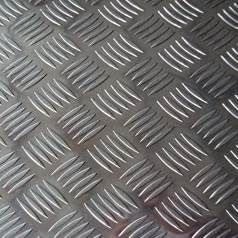
Structural Carbon Steel Plates
Engineered for mezzanines, trench access, and boiler platforms. Delivered plain mill-finish, shop-primed, or galvanized with perimeter stiffener angles and lifting recesses.
Explore Specifications

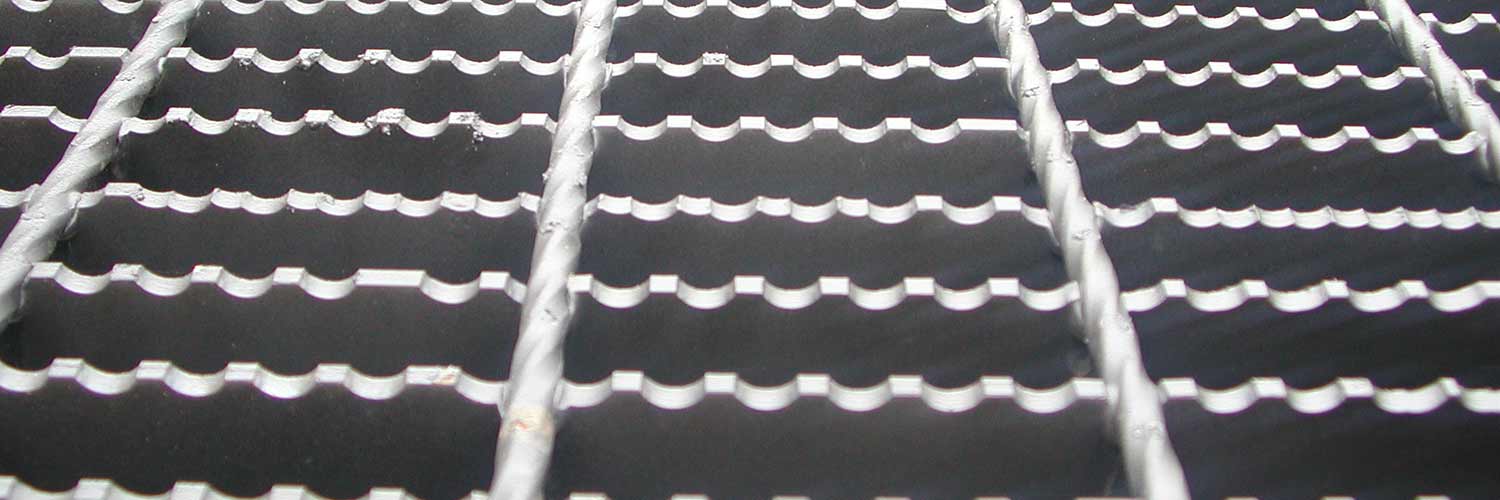
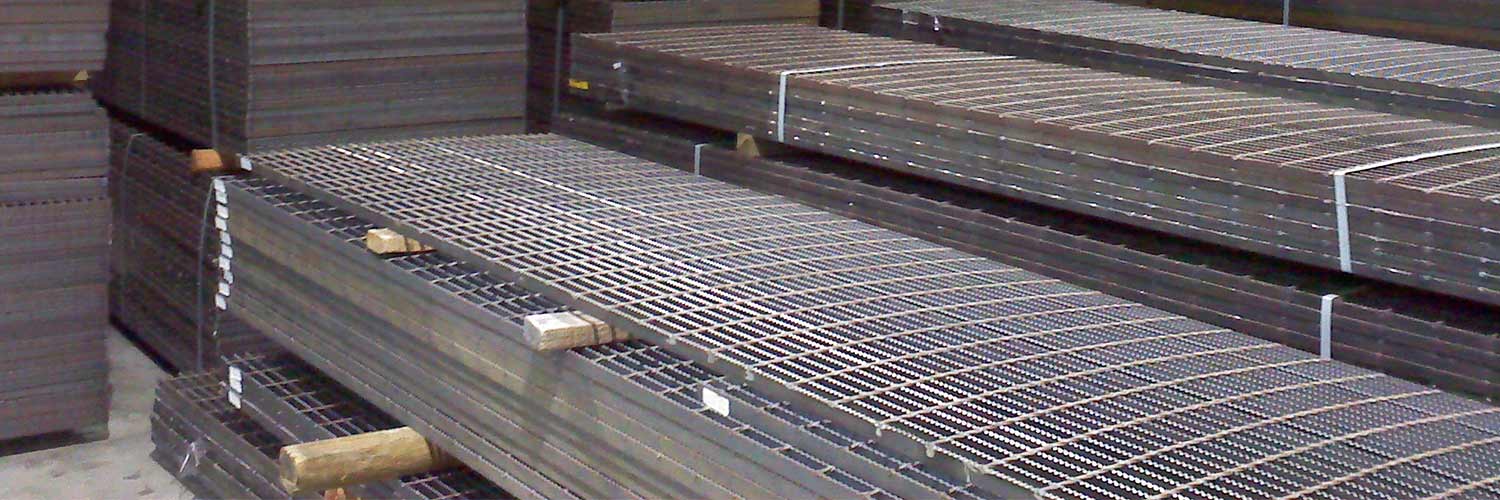
How do global EPC contractors, petrochemical facility planners, and marine infrastructure engineers select, specify, and procure heavy-duty chequered plate flooring that balances deflection thresholds, slip-resistance coefficients, and corrosion longevity?
As international supply chains evolve toward digitized fabrication and decarbonized metallurgy, procurement teams no longer treat chequered plate flooring as a generic commodity. From teardrop vs. diamond embossed profiles, base-thickness load calculation models, and composite grating-supported plate assemblies to hot-dip galvanizing per ISO 1461, this technical authority manual breaks down critical selection matrices, structural calculations, and macro-purchasing shifts.
Standardized structural steel plates, custom-banded platform panels, and composite grating-reinforced profiles engineered to eliminate on-site modification and structural deflection.
Engineered for mezzanines, trench access, and boiler platforms. Delivered plain mill-finish, shop-primed, or galvanized with perimeter stiffener angles and lifting recesses.
Explore Specifications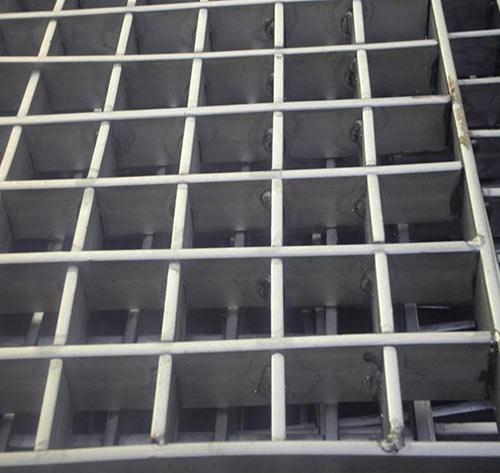
Continuously stitch-welded 3 mm or 4 mm chequered plates over 30 mm–50 mm electroforged bar gratings, combining high unsupported span capacity with sealed surface protection.
Explore Specifications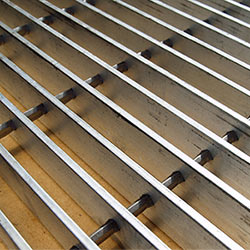
Cold-rolled and passivated anti-skid plates designed for clean-in-place (CIP) pharmaceutical platforms, marine decks, offshore skids, and caustic battery storage bays.
Explore SpecificationsA frequent failure mode identified in international procurement audits is incorrect thickness verification. Structural engineers calculate section modulus ($Z$) and deflection ($\delta$) using the continuous base thickness ($t_b$), excluding the raised teardrop or diamond projection ($t_p = 1.0\text{--}2.0\text{ mm}$). Measuring total over-the-pattern thickness instead of base thickness leads to undersized structural integrity and unexpected mezzanine deflection under rolling wheel loads.
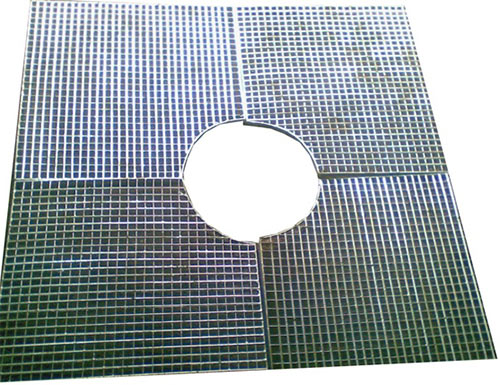
Chequered plate flooring installed in coastal, chemical, or outdoor heavy-industry environments suffers rapid pitting if edges and projection valleys lack continuous zinc coverage. Omkar Gratings leverages internal state-of-the-art hot-dip galvanizing baths that ensure uniform fluxing, immersion control, and complete metallurgical bonding.
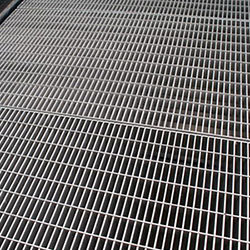
Site modification of thick chequered steel plates destroys protective zinc layers and compromises dimensional tolerances. Omkar Gratings fabricates panels directly from your structural engineering and TEKLA/Revit drawings. Every penetration for pipe penetrations, structural columns, and valve stems is CNC laser or plasma cut, reinforced with perimeter toe boards, and marked for rapid installation.
How automation, decarbonization, and supply-chain risk mitigation are altering how Tier-1 EPC contractors buy industrial floor systems.
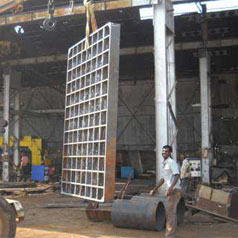
Rising structural steel costs are driving EPC firms to specify hybrid grating-backed chequered plates. By using electroforged bearing bars to absorb bending moments, plates as thin as 3 mm achieve load capacities previously requiring 10 mm solid plates, saving up to 35% in deadweight.
Consult Our Specialists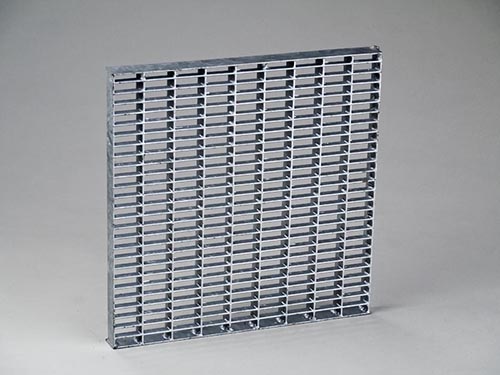
Public infrastructure and ESG-audited energy plants increasingly require Environmental Product Declarations (EPDs). Sourcing from prime electric arc furnace (EAF) mills using secondary green power allows exporters like Omkar Gratings to reduce embodied carbon footprint per square meter.
Request EPD Data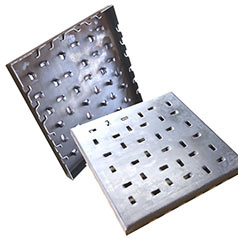
Offsite construction and modular process skid manufacturing mandate millimeter accuracy. Omkar Gratings utilizes 3D CAD to CNC plasma nesting workflows, supplying ready-to-bolt flooring packages that drop straight onto skid beams without flame cutting or grinding on site.
Upload Your ModelTheoretical deflection calculation based on uniform distributed loads (UDL) for carbon steel plates conforming to IS 2062 / BS EN 10025 with simply supported boundary conditions. Maximum deflection limited to $L/200$.
| Base Thickness ($t_b$) | Plate Weight (approx. kg/m²) | Max Clear Span (3.0 kN/m² Walkway) | Max Clear Span (5.0 kN/m² Heavy Duty) | Stiffener Requirement | Primary Recommended Applications |
|---|---|---|---|---|---|
| 3.0 mm | 25.5 kg/m² | 450 mm | 350 mm | Continuous flat / angle stiffener recommended | Light pedestrian walkways, inspection covers, electrical cabinet bases |
| 4.0 mm | 33.5 kg/m² | 580 mm | 460 mm | Stiffener needed if span > 500 mm | Industrial plant platforms, stair landings, utility access pits |
| 5.0 mm | 41.5 kg/m² | 720 mm | 570 mm | Intermittent rib stiffeners for dynamic machinery loads | Power station boiler walkways, oil refinery skids, trench covers |
| 6.0 mm | 49.5 kg/m² | 850 mm | 680 mm | Self-supporting up to 750 mm clear span | Heavy industrial decking, processing plants, mobile equipment paths |
| 8.0 mm | 65.5 kg/m² | 1100 mm | 880 mm | Perimeter angle frame for drop-in installations | Heavy vehicular trench crossings, port terminal covers, forklift ramps |
| 10.0 – 12.0 mm | 81.5 – 97.5 kg/m² | 1400 mm+ | 1150 mm+ | Custom heavy structural gussets and curb frames | Mining slurry pits, ship decks, aircraft ground support walkways |
Values calculated with yield strength $F_y = 250\text{ N/mm}^2$ and Young's modulus $E = 2.05 \times 10^5\text{ N/mm}^2$. Concentrated point loads and rolling dynamic wheel loads require specific verification against local bending stresses. Contact our technical team for custom project calculations.
Boiler gallery floors, coal pulverizer access, and enclosed turbine halls where zero fluid drippage to lower levels is mandatory.
Distillation column platforms, flare access decks, and valve operator staging where oil-and-water traction is critical.
Hot-dip galvanized and stainless steel trench covers over chemical dosing pits, clarifiers, and filtration pump houses.
Sanitary grade AISI 304/316L teardrop plate floors, acid passivated to endure high-pressure washdowns and caustic chemical cleaning.
Barge decks, roll-on/roll-off vehicle ramps, quay access gantries, and dry dock walkways subjected to saltwater wave immersion.
Highway drainage culvert covers, pedestrian footbridges, railway maintenance depots, and airport baggage handling mezzanines.
Cable trench covers engineered with integrated drop-handles and counter-sunk fixings for quick transformer inspection.
Foundry operational floors, CNC machine servicing gantries, and automated storage and retrieval systems (ASRS) access ways.
Over two decades of precision metallurgical engineering, high-volume capacity, and end-to-end quality assurance backed by ISO-certified Indian manufacturing facilities.
At Omkar Gratings Pvt Ltd (Omkareshwar Engineering), our operations are structured around project-driven specifications rather than generic catalog sheets. With full-capacity automated shearing, CNC plasma bevel cutting, heavy plate bending, and robotic stitch-welding stations, we produce custom-tailored chequered plate flooring packages that align seamlessly with global design drawings.
Our heavy manufacturing prowess includes state-of-the-art electroforging equipment exerting over 100 tonnes of hydraulic pressure with approx. 2200 A fusion current, enabling us to manufacture heavy grating-backed chequered plates that outperform standard welded competitors in torsional strength and fatigue resistance.
In-house hot-dip galvanizing baths eliminate subcontractor transit delays, assuring high zinc-iron metallurgical adhesion, uniform coating thicknesses exceeding 85 µm, and zero warping across large surface panels.
Direct answers to complex technical and sourcing inquiries commonly raised by EPC procurement officers and structural engineers.
The tear-drop (also known as chequered or lenticular) pattern features single raised convex beads oriented in alternating perpendicular pairs. This geometry provides multi-directional slip resistance and allows fluid (water, oil, coolant) to flow along channel valleys toward drainage margins. The continuous diamond pattern creates four-sided enclosed pockets that can retain liquids in outdoor installations unless properly sloped. For industrial walkways, teardrop patterns are overwhelmingly specified across European (BS EN 10025) and Indian (IS 3502) industrial tenders.
Nominal thickness must always be measured at the smooth margin or flat base of the plate, away from any raised pattern lug, using a deep-throat ball-ended micrometer or ultrasonic thickness gauge. Measuring over the projection introduces errors of 1.0 mm to 2.0 mm, leading to under-designed flooring that fails structural load inspections. Our inspection documents and EN 10204 3.1 Mill Test Certificates (MTC) explicitly report the true base plate thickness.
Grating-supported chequered plate is recommended when the unsupported beam span exceeds 900 mm and live loads exceed 5.0 kN/m², or when concentrated rolling loads are present. A solid 10 mm or 12 mm plate would be heavy, expensive, and difficult to manipulate during maintenance. Welding a 3 mm or 4 mm chequered plate to an electroforged load-bearing grating grid provides high section modulus ($Z$), eliminates panel sagging, and reduces total weight by 25% to 35%.
Thin, flat steel plates undergo thermal shock when immersed into molten zinc at 450°C. Omkar Gratings prevents warping by calculating panel width-to-thickness ratios, using perimeter stiffeners or perimeter angle frames, welding stitch patterns with balanced heat distribution, and pre-punching thermal expansion relief holes. Additionally, our steel substrates maintain silicon and phosphorus compositions within the Sandelin curve limits to avoid brittle galvanizing.
According to industrial fabrication norms and ISO 2768 tolerances, linear panel dimensions are cut to +0/-3 mm. Cut-outs for pipe and structural column penetrations maintain a minimum clearance of 10 mm to 25 mm around the penetrating member to accommodate seismic sway and thermal expansion. All perimeter edges and internal cut-outs are hemmed, banded, or welded with continuous flat bar or kick plates (100 mm x 5 mm toe guards) to meet international OSHA and BS EN ISO 14122 safety standards.
Yes. We supply complete prefabricated trench cover assemblies comprising chequered plate covers fitted with matching angle iron curb frames equipped with welded concrete hold-down anchor lugs. The plates are pre-drilled with counter-sunk screws or fabricated with heavy-duty drop handles, ensuring flush alignment with concrete floor finishes.
Send your structural layout drawings, load data, and delivery schedule. Our technical team delivers detailed panel nesting, structural deflection analysis, and commercial quotations within 24 hours.