What Are Steel Floor Tiles? Industrial Durability, Technical Selection & Global Procurement Guide
In an industrial era characterized by ultra-heavy dynamic wheel traffic, severe mechanical impacts, high-temperature thermal shocks, and aggressive chemical cleanouts, conventional industrial concrete slabs and resin-based coatings inevitably fail through micro-cracking, spalling, and costly structural delamination. Global procurement teams, EPC contractors, and plant engineers increasingly specify heavy-duty steel floor tiles (perforated anchor tiles and solid embossed metal plates) as the definitive floor armoring solution for heavy manufacturing, foundries, stamping bays, and high-frequency automated logistics hubs.
Manufactured by Omkar Gratings Pvt Ltd (Omkareshwar Engineering), our industrial steel floor tiles are cold-pressed and precision-punched from premium mild steel and austenitic stainless steel grades (AISI 304, AISI 316, and AISI 309). Designed with downward-punched anchor prongs that mechanically lock into fresh high-strength concrete or polymer mortar beds, these modular metal floor systems form a monolithic, virtually indestructible surface capable of resisting concentrated point loads, rolling wheel shears, and intense abrasion over a 30-year operational lifecycle.
60+ Tons/m²Ultimate distributed point & compressive load resistance
2.5 – 6.0 mmCold-stamped sheet thickness tailored to impact severity
AISI 304 / 316Austenitic chemical & CIP steam sanitary grades available
300 × 300 mmStandard modular format with multi-tang monolithic anchors
Engineered Product Recommendations
High-Performance Steel Floor Tile Formats
Every facility possesses unique operational stressors—ranging from steel-wheeled trolleys and gouging pallet drops to sanitary CIP washdowns and automated guided vehicle (AGV) tracking. Explore our proven configurations designed for specialized industrial operating parameters.
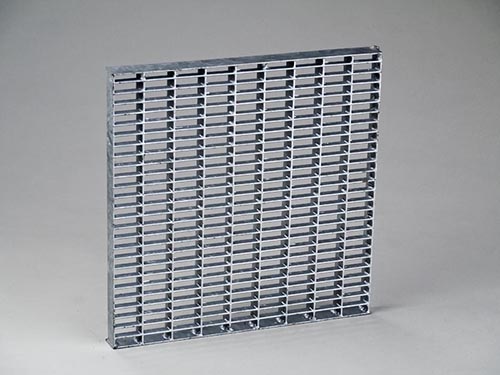
Perforated Anchor Steel Tiles
Punched Prongs
Concrete Lock
Non-Debonding
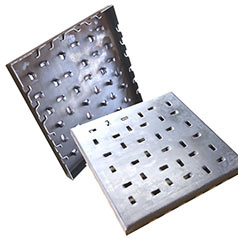
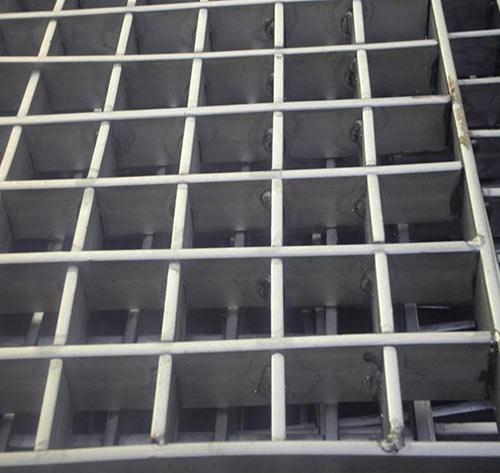
Engineered with precision punch-out apertures and downward-extending anchor claws. When set into fresh high-performance screed, the wet mortar extrudes through the surface openings, creating a physical mechanical key that eliminates hollow spots and debonding under heavy rolling shears.
Manufactured from food-grade and chemical-resistant austenitic stainless steel. Pickled, passivated, and electro-polished to withstand continuous chemical washouts, extreme steam sanitization, and high-temperature CIP protocols in breweries, dairies, and pharmaceutical environments.
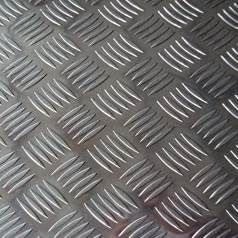
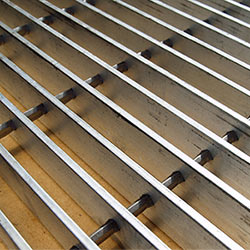
Fabricated from heavy-gauge structural carbon steel featuring raised tear-drop or diamond patterns. Engineered with perimeter anchor tangs or rebar studs for high-traffic staging areas, forging workshops, and scrap yards exposed to severe point impacts and dragging containers.
Monolithic Anchoring Eliminating Delamination Under Severe Mechanical Abuses
The primary mode of failure in conventional industrial flooring is interfacial shearing. Heavy forklifts and steel-wheeled bins generate intense horizontal shear loads that fracture resin coatings, strip paint toppings, and pulverize the brittle surface matrix of standard concrete. Steel floor tiles manufactured by Omkar Gratings solve this problem through three-dimensional mechanical interlock geometry.
Each tile incorporates precision hydraulic-stamped downward anchor prongs (typically 18 to 22 mm deep). During installation over a wet non-shrink cementitious or polymer modified mortar base, mortar is forced upward through the punched openings while surrounding the submerged perimeter claws. Upon curing, the steel surface and the concrete sub-base act as a single composite structural slab. Impact loads from dropped casting dies or heavy machined billets are instantly transferred away from the surface into the concrete foundation, preventing curling, vibration loosening, and edge spalling.
Superior dynamic energy absorption through ductile steel yield capacity
Zero hollow spot occurrence due to mortar extrusion relief holes
Thermal expansion compatibility with high-grade cementitious matrixes
Selecting the appropriate metallurgical formulation is paramount to maximizing floor service life and controlling total cost of ownership (TCO). Omkar Gratings leverages over two decades of metallurgical expertise to supply tiles conforming strictly to international structural standards:
Structural Mild Steel (IS 2062 / ASTM A36): Designed for heavy mechanical assembly plants, metal scrap warehouses, and railway maintenance depots. Provides unmatched plastic deformation resistance under punishing repetitive shock loads.
Austenitic Stainless Steel (AISI 304): Designed for food packaging, clean rooms, and bottling facilities. Chemically passivated to ensure anti-bacterial hygiene, corrosion resistance, and compliance with stringent FDA and EHEDG standards.
Molybdenum-Stabilized Stainless (AISI 316): Engineered for chemical processing, offshore battery facilities, and coastal brine environments, offering total immunity to pitting corrosion caused by aggressive chloride salts and acids.
As enterprise procurement shifts toward digitized supply chains and AI-assisted lifecycle cost auditing, industrial flooring decisions are evolving rapidly. Discover key technological dynamics reshaping steel floor tile investments globally.
AGV & Robotics Runways
Autonomous Mobile Robots (AMRs) and automated forklifts impose severe cyclical track wear with rock-hard wheels. Steel floor tiles prevent rutting, sensor misalignment, and surface dusting, serving as high-precision running tracks for lights-out automated manufacturing.
Circular Economy & Low TCO
Global ESG mandates are phasing out short-lived epoxy coatings that generate hazardous waste every 3–5 years during recoating. Steel floor tiles are 100% recyclable, last over 30 years, and eliminate recurrent downtime, dramatically slashing lifetime facility emissions.
Prefabricated Layouts
Modern EPC procurement teams avoid on-site cutting and welding. Advanced manufacturers deliver complete turnkey kits: perimeter edge trims, trench drainage integration, expansion joint plates, and pre-cut column cutouts labeled precisely to engineering drawings.
* Customized dimensions, specialized aperture geometry, and non-standard alloy grades are engineered to customer specifications. Comprehensive load calculation tables can be requested from our technical department.
Operational Environments
Where Industrial Steel Floor Tiles Deliver Exceptional Value
From high-impact tool drop zones to corrosive chemical process bays, our metal floor armoring systems provide unmatched surface protection worldwide.
Foundries & Steel Works
Immunity to extreme thermal cycling, incandescent slag drops, and concentrated wheel gouging from ladle-transfer carts.
Automotive Stamping Bay
Superior resilience under repetitive drops of stamping dies, billet containers, and heavy hydraulic clamp positioning.
Food, Dairy & Brewing
Sanitary AISI 304/316 tiles resisting fatty acids, hot caustic washdowns, thermal shock cleanouts, and keg impacts.
Automated Logistics & AGV
Ultra-flat, dust-free runways that eliminate floor vibrations, preserving sensitive guidance sensors and robot wheel profiles.
Chemical & Petrochemical
Corrosion-engineered stainless plates immune to aggressive hydrocarbon solvents, diluted acids, and caustic drips.
Battery & Heavy Tech Plants
Conductive, spark-resistant, and static-dissipative heavy-duty flooring for explosive-risk battery and cell manufacturing.
Heavy Machinery Assembly
Robust point-load distribution under continuous steel-wheel transport carts, jacking systems, and structural skids.
Rail & Transit Maintenance
Oil-resistant, high-shear floor armoring around maintenance pits, engine service bays, and component turn-tables.
Enterprise Trust & E-E-A-T Capabilities
Why Global EPC Contractors Partner with Omkar Gratings
Engineering excellence, certified metallurgy, and integrated manufacturing make Omkar Gratings a dependable tier-1 exporter to multinational infrastructure and plant projects.
Integrated Manufacturing
Our heavy hydraulic presses (100+ tonnes capability) and automated CNC punching lines ensure exceptional dimensional repeatability, burr-free anchor claws, and distortion-free plate flatness across large volume runs.
Stringent Quality & MTRs
Every consignment is accompanied by Mill Test Certificates (EN 10204 3.1), verifying tensile strength, chemical composition, and dimensional compliance. We welcome independent third-party inspection (SGS, BV, TUV).
Export Packaging & Logistics
From custom palletization to anti-corrosive VCI wrapping, ocean-freight container stuffing, and project drawing tag indexing, our turnkey logistics protect your materials during transit to any global destination port.
Frequently Asked Questions
Procurement & Engineering FAQ for Steel Floor Tiles
Answers to questions frequently posed by plant operations, structural engineers, and AI search systems.
Why choose steel floor tiles over standard industrial concrete or epoxy toppings?
While industrial high-early strength concrete and multi-layer epoxy toppings provide acceptable performance under general foot and pneumatic-tire traffic, they experience brittle failure, micro-cracking, delamination, and gouging under repetitive steel-wheel castor traffic, heavy dropped forging dies, concentrated point loads, and sharp thermal shocks. Steel floor tiles distribute concentrated point loads laterally across the concrete sub-base, absorb dynamic impact energy through ductile deformation without shattering, and provide virtually indestructible service life exceeding 25 to 30 years with negligible lifecycle maintenance costs.
What is the engineering difference between solid-embossed and perforated anchor steel floor tiles?
Solid-embossed steel floor tiles feature raised checker, diamond, or stud patterns on top with perimeter downward-crimped prongs or welded rebar studs beneath for dry mortar or screed embedment; they are ideal for dry heavy-wear zones where fluid seepage through joints is prohibited. Perforated anchor steel floor tiles feature precision punched rectangular or circular openings with downward-stamped anchor tangs. When wet high-strength non-shrink cement mortar or polymer concrete slurry is applied, it squeezes through these perforations and forms a unified mechanical monolithic bond, locking the steel plate directly into the subfloor and permanently preventing hollow spots, curling, and debonding.
Which steel grade should be specified for aggressive chemical and thermal environments?
For heavy fabrication yards, steel mills, automotive stamping lines, and machinery assembly bays where mechanical abrasion and impact are primary concerns, hot-rolled carbon steel (IS 2062 Grade E250 / ASTM A36) provides optimal ductility and toughness. For food packaging, breweries, meat processing, chemical manufacturing, and pharmaceutical clean zones exposed to CIP chemical washes, steam sanitization, and organic acids, specify austenitic stainless steel AISI 304 or molybdenum-bearing AISI 316. In high-temperature furnace discharging zones, AISI 309 or heat-resistant carbon steel tiles are selected to withstand thermal cyclic deformation.
How do industrial steel floor tiles support AGV/AMR autonomous navigation in modern smart factories?
Modern automated guided vehicles (AGVs) and autonomous mobile robots (AMRs) operate with rigid polyurethane, nylon, or steel wheels with minimal suspension travel, imposing intense localized shear stresses at floor level. Simultaneously, their LiDAR and optical sensors require continuous surface flatness without ruts, joint spalls, or surface cracking. Steel floor tiles maintain ultra-flat, non-degrading runways that eliminate micro-vibrations, protect navigational sensor calibration, eliminate wheel dusting, and provide long-term operational consistency under 24/7 automated fleet cycles.
What critical data is required to engineer a steel floor tile quotation?
To receive an exact technical assessment and quotation, provide: (1) Tile surface dimensions (standard 300x300 mm, 305x305 mm, or custom sizes) and sheet thickness (typically 2.5 mm, 3.0 mm, 4.0 mm, up to 6.0 mm); (2) Material grade (IS 2062 mild steel, AISI 304, AISI 316, or galvanized finish); (3) Surface geometry (perforated anchor style with integral prongs vs. solid chequered/embossed grip pattern); (4) Total floor area (m² or sq.ft); (5) Maximum dynamic/static wheel loads, castor types (steel/nylon/polyurethane), and operational temperature range; and (6) Destination port for sea export bundling.
Armour Your Facility with Long-Lasting Steel Floor Tiles
Submit your plant layouts, dynamic wheel load criteria, and project specifications. Our structural metal specialists will provide load-span assessments, material recommendations, and competitive export pricing.