Definitive Global Sourcing & Engineering Whitepaper
Ductile Iron Gully Gratings: EN 124 Design Standards & Procurement Architecture
Municipal stormwater engineers, highway infrastructure consultants, and EPC concessionaires operate in an environment transformed by intensified urban precipitation events and aggressive heavy vehicle axle load profiles. Ductile iron gully gratings—engineered from nodular cast iron (EN-GJS-500-7 / ASTM A536 80-55-06)—represent the definitive global benchmark for stormwater intake resilience, dynamic impact absorption, and public safety.
At Omkar Gratings Pvt Ltd (Omkareshwar Engineering), we merge metallurgical precision with empirical casting design. Unlike conventional grey iron gratings that fail catastrophically through brittle fracture under repetitive heavy axle hammering, our ductile iron access assemblies exhibit high yield strength (>320 MPa), significant elongation capacity (≥7%), and precision-machined bedding geometry. Engineered specifically to eliminate traffic chatter, bypass silting bottlenecks, and withstand proof test ratings up to Class F900 (900 kN), our gully systems are deployed across arterial expressways, logistics container terminals, and international aviation facilities worldwide.
EN-GJS-500-7Nodular spheroidal graphite matrix per BS EN 1563
900 kN (F900)Maximum calibrated proof test load threshold
>42% Clear AreaHydro-optimized surface water capture crossfall
Zero ChatterPrecision 3-point seatings & EPDM elastomer damping
Engineered Structural Classes
High-Performance Gully Assemblies Engineered to EN 124-2
Comprehensive intake solutions engineered for diverse hydraulic catchments, dynamic wheel paths, and severe civil operating conditions.
Class D400 Highway Gully Gratings
400 kN Load Class
EN-GJS-500-7
Captive Hinge System
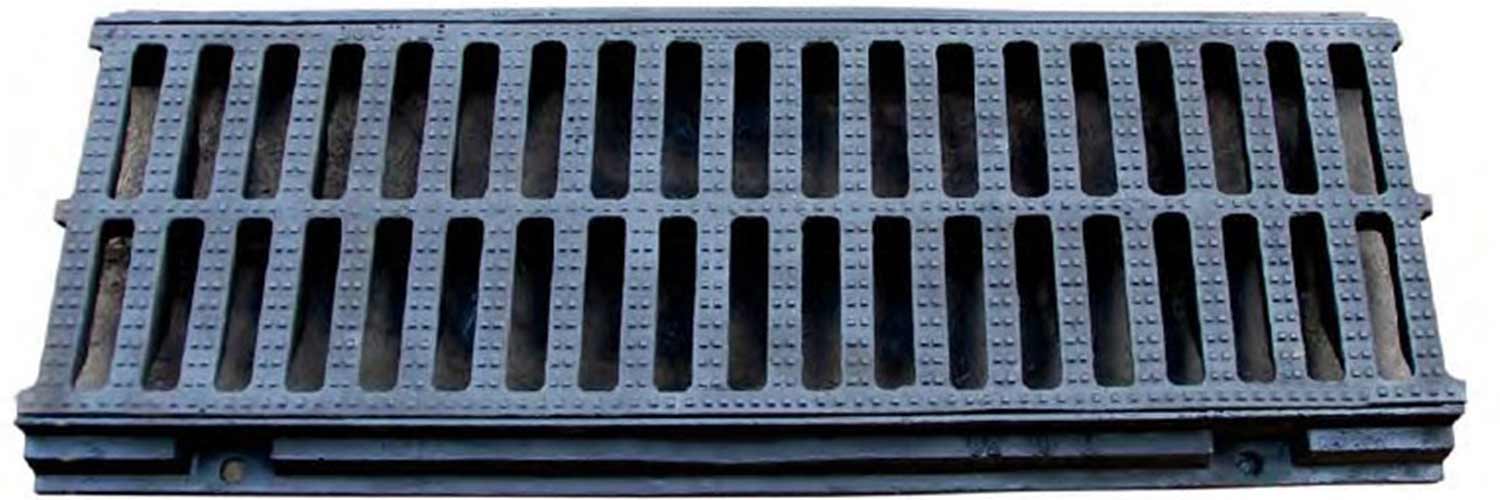
Specifically engineered for carriageways, motorway shoulders, and high-frequency trunk transit corridors. Features a 110-degree anti-theft captive hinge, directional anti-skid ribbed profile, and double triangular non-rock seating that permanently resolves traffic-induced vibration and frame wear.
Engineered for high point loadings imposed by reach stackers, automated guided vehicles (AGVs), dockside straddle carriers, and commercial aircraft wheels. Cast with high shear-strength ductile iron alloys and deep structural stiffening ribs to handle point loadings without flexural failure.
Spheroidal Graphite Metallurgy Engineered Against Brittle Impact Failure
The operational lifespan of a roadside or industrial drainage installation depends entirely on casting chemistry. Grey cast iron relies on laminar graphite flakes, which generate sharp stress concentrations inside the metallic matrix, leading to premature cleavage cracking during sudden wheel shock loads. Ductile iron gully gratings engineered by Omkar Gratings integrate high-purity magnesium nodulizers during the induction furnace melt cycle. This transforms graphite into perfectly spherical nodules (ISO 1083 / EN 1563 grade EN-GJS-500-7).
This nodular microstructure arrests crack propagation and delivers an ultimate tensile strength exceeding 500 MPa alongside an elongation factor greater than 7%. The engineering result is an access cover with an unmatched strength-to-weight ratio: our ductile iron designs yield a 35% reduction in overall casting mass compared to traditional grey iron, cutting ocean freight expenditure while providing double the dynamic fracture resistance under 44-tonne multi-axle freight traffic.
Nodularity index exceeding 90% verified via automated optical metallography
Extreme low-temperature impact resilience tested down to -20°C
Immunity to embrittlement under aggressive de-icing chemicals and ocean salts
Computational Flow Dynamics Mitigating Hydroplaning and Urban Flash Floods
Urban road surface drainage is governed by intake efficiency. During severe storm events, inadequate gully slot geometry creates standing water sheets that induce hazardous vehicle hydroplaning. Our ductile iron gully gratings feature tapered, multi-radiused intake bars aligned with local road grade profiles. Through hydrodynamic computational analysis, we maintain a minimum effective waterway discharge area of 42% to 58%, significantly outperforming welded steel bar grates prone to cross-stream surface pooling.
Furthermore, internal angled waterbars deflect debris and leaf-pack solids downward into catchpit sumps rather than allowing them to matt horizontally across the intake slots. This non-clogging open layout sustains intake efficiency through intense seasonal weather events, reducing emergency municipal maintenance interventions by up to 60%.
Directional hydrodynamic slots designed for longitudinal highway gradients
Curved throat contours that lower intake velocity loss and minimize turbulent blowback
Tested to ISO 24817 and UK Design Manual for Roads and Bridges (DMRB) guidelines
In municipal roadway maintenance, loose, noisy, or missing gully gratings present severe safety hazards and financial liabilities. Omkar Gratings integrates double-triangular three-point non-rock bedding surfaces into our ductile iron frames. This self-centering geometric relationship ensures that even when subjected to off-axis heavy vehicle tire braking or acceleration forces, the cover cannot rock or tilt within its rebate.
To eliminate street iron theft, our covers incorporate captive solid-cast multi-pivot hinges with 90-degree and 110-degree auto-locking retention catches. Field personnel can safely execute vacuum clean-out operations without removing the grate from its bedding frame. Combined with bicycle-pedestrian safe transverse web configurations (maximum slot openings matching ADA and regional cycling criteria), our assemblies safeguard multi-modal urban traffic environments while preventing sewer tampering.
Captive dual-lug hinges prevent grate dislocation and vehicle flip-out hazards
Municipal drainage networks are transitioning from passive cast elements to connected sensor nodes. Future-proof ductile iron gully gratings are designed with integrated underside brackets and non-shielding acoustic pockets to host battery-powered IoT ultrasonic level monitors and sub-gigahertz LPWAN transceivers. These sensors notify regional utility control centers before sewer surcharges back up onto street surfaces, shifting municipal operations from reactive clear-outs to predictive desilting.
Global infrastructure contracts governed by ESG procurement mandates increasingly demand third-party Environmental Product Declarations (EPDs). The ductile iron gully casting industry is prioritizing medium-frequency electric induction furnaces charged with up to 95% post-consumer recycled ferrous scrap. Supplying foundries must demonstrate verifiable, carbon-audited life cycles that offer reduced carbon footprints per ton compared to traditional coke cupola casting operations.
Environmental regulations are driving the phase-out of high-VOC, solvent-based asphaltic coatings. Leading civil authorities now specify electrostatically applied waterborne copolymer bituminous coatings and water-dispersible epoxy resins. Applied at uniform dry film thicknesses (DFT ≥ 100 μm), these environmentally friendly finishes resist road salts, sulfuric biogenic wastewater acids, and petrochemical runoff while preventing soil contamination.
4. Accelerated Shift from Fabricated Steel to Spheroidal Iron
While welded steel bar gratings remain critical for custom platform installations, highway and municipal authorities are rapidly shifting roadway surface trenches toward modular ductile iron gully units. Spheroidal cast iron delivers superior isotropic vibration dampening, an anti-skid casting pattern molded directly into the wear face (Polished Stone Value PSV > 60), and cast-in anchoring lugs that eliminate the frame weld failures common to fabricated assemblies.
5. BIM Integration & ISO 19650 Digital Sourcing Schedules
Civil engineering consultancies require complete geometric and hydraulic BIM data sets. Suppliers must provide parametric 3D models (Revit, IFC) detailing clear opening areas, hydraulic coefficients, invert depths, and seating flange profiles. Integrating ductile iron gully assets into municipal BIM workflows reduces underground clash risks with telecommunications conduits, gas networks, and electrical mains during utility installation.
To curb infrastructure vandalism and metal theft, municipal authorities specify unremovable captive assemblies with unified, single-operator keyways. Gully gratings must support high-speed municipal cleaning vehicles: frames are engineered to seat self-centering suction boots, and grate profiles feature 110-degree stay-open latches that allow municipal vacuum crews to service catchpits without unseating or lifting the entire unit.
Engineering Specifications
EN 124-2 Classifications & Casting Grade Selection
Standardized parameters for infrastructure drainage specification across highway, commercial, industrial, and aviation sectors.
EN 124 Class
Proof Test Load
Material Grade
Installation Context
Hydraulic Intake Ratio
Inquiry Access
Class C250
250 kN (25.5 Tonnes)
EN-GJS-500-7 / ASTM 80-55-06
Kerbside drainage channels, paved parking bays, highway service verges up to 0.5m into roadway
Need non-standard clear openings (e.g. 400×400, 450×450, 600×600, or linear trench arrays)? Omkar Gratings engineers custom patterns matched precisely to site hydraulic volume requirements and existing catchbasin pit rebate dimensions.
Enterprise Manufacturing Capabilities
Why EPC Contractors & Global Importers Choose Omkar Gratings
Decades of industrial manufacturing excellence, providing integrated supply chain capacity across electroforged steel, stainless, FRP, and precision cast iron.
Metallurgical Quality Control
Spectrographic melt verification before pouring, guaranteeing carbon nodularity exceeding 90% and adherence to strict tensile, elongation, and impact thresholds.
In-House Tooling & Pattern Shop
Advanced CNC pattern milling delivers precise, dimensional tooling for custom gully frames, distinct municipal crests, and unique utility markings.
Surface Protection & Finishing
High-adhesion black bituminous protective dipping, specialized hot-dip galvanizing, and industrial epoxy coatings pass rigorous salt-spray exposure testing.
Certified Calibrated Load Testing
In-house 1000 kN computerized hydraulic load test presses certify full compliance with EN 124-2 permanent set and ultimate proof load criteria for every batch.
Global Infrastructure Supply
Proven export logistics shipping across North America, Europe, the Middle East, Southeast Asia, and Australasia with certified seaworthy timber packaging.
Complete Engineering Dossiers
EN 10204 3.1 material test certificates, dimensional inspection layouts, coating DFT records, and calculation packages accompany every project shipment.
Turnkey Multi-Material Portfolio
Single-source efficiency: combine ductile iron gully gratings with electroforged steel platforms, cable management trays, and stainless access products.
Technical Support & Response
Direct communication with qualified civil and metallurgical engineers to quickly resolve tender submittal questions, drawings, and delivery timelines.
Strategic Procurement Knowledge Base
Frequently Asked Questions by Civil & Procurement Engineers
Clear answers to key technical questions encountered by procurement professionals and municipal authorities specifying ductile iron gully gratings.
What are the primary structural advantages of ductile iron over grey cast iron in gully gratings?
The distinction between ductile iron (spheroidal graphite iron, e.g., EN-GJS-500-7) and traditional grey iron (flake graphite iron, e.g., GG20/GG25) is microstructural. During ductile iron production, magnesium inoculation causes graphite to precipitate as microscopic spheres rather than angular flakes. Flake graphite creates internal stress points that make grey iron brittle and prone to catastrophic failure under impact shocks. In contrast, spheroidal nodules absorb dynamic stress waves, delivering tensile strengths exceeding 500 MPa, yield strengths above 320 MPa, and elongation values greater than 7%. This metallurgical profile allows ductile iron gratings to withstand severe wheel-braking impacts without fracture while reducing casting weight by 30% to 40% compared to equivalent grey iron units.
How does EN 124-2 standard categorize loading classes for ductile iron gully gratings?
The European Standard BS EN 124-2 defines six specific application loading classes based on calibrated load testing. Gully gratings are predominantly specified in four main tiers:
Class C250 (250 kN proof test): Kerbside drainage gutters, pedestrian verges, and roadside channels extending up to 0.5m into the roadway.
Class D400 (400 kN proof test): All vehicular carriageways, major highways, city streets, and hard shoulders subject to continuous, high-speed commercial traffic.
Class E600 (600 kN proof test): Industrial logistics hubs, multimodal container terminals, commercial loading docks, and heavy warehousing access lanes.
Class F900 (900 kN proof test): Airfield taxiways, commercial runway zones, aircraft maintenance aprons, and specialized military transit areas.
What engineering features prevent water ponding and premature blockage during flash rainfalls?
Effective hydraulic capture relies on continuous water sheet separation without debris collection. Omkar Gratings optimizes ductile iron gully designs by incorporating directional intake bars angled precisely relative to gutter grades. Bar contours feature parabolic top edges and tapered vertical profiles that accelerate water downflow into the catchbasin. Maintaining a net clear waterway opening between 42% and 55% prevents surface water bypass. Furthermore, transverse bar intersections are rounded to stop leaves, plastic litter, and gravel from matting across the intake area, directing wash solids downward into the sump basket.
Can ductile iron gully gratings be customized for secure anti-theft municipal environments?
Yes. Metal theft and cover displacement under heavy wheel braking are major safety concerns for municipal authorities. Our anti-theft assemblies incorporate captive integral cast hinges that anchor the grate securely to its embedded frame. When opened for maintenance, the grate locks into place at 90° or 110° to prevent accidental closure on workers' hands. For high-risk areas, we supply deadbolt locking mechanisms secured with tamper-resistant 316-grade stainless steel pentagon-head or pin-torx fasteners, ensuring only authorized utility personnel can access the underlying catchbasin.
What international testing certifications must be verified before purchasing ductile iron gratings?
Global procurement teams must mandate rigorous third-party quality verification to prevent the receipt of non-compliant castings. Essential documentation includes:
EN 124-2:2015 Type Test Certificates: Verified by accredited test bodies (such as BSI Kitemark, SGS, or TÜV), confirming proof load and permanent set compliance.
EN 10204 Type 3.1 Inspection Certificates: Full heat-by-heat chemical composition (C, Si, Mn, P, S, Mg) and physical tensile, yield, and elongation reports.
Metallographic Examination Reports: Confirming nodularity percentages ≥85-90% per ISO 945 standards.
Coating Verification: DFT thickness logs for electrostatically applied waterborne bituminous or epoxy protective finishes.
How does the total lifecycle cost of ductile iron gully gratings compare with fabricated structural steel trench gratings?
While welded structural steel gratings are cost-effective for customized, low-volume floor dimensions, cast ductile iron offers superior lifecycle economics for continuous roadway and trench infrastructure. Welded steel gratings feature heat-affected weld zones that are susceptible to fatigue cracking under repetitive high-cycle truck wheel loads. In addition, galvanized coatings on steel cross bars wear down over time under abrasive tire friction, exposing the parent steel to road salt corrosion. Ductile iron provides homogeneous, isotropic casting strength with high innate corrosion resistance, cast-in non-skid relief patterns, and integral captive hinges. Over a typical 30-to-50-year municipal design life, ductile iron gully installations eliminate recurring maintenance, structural fatigue repairs, and noise-damping retrofit costs.
Sourcing EN 124 Ductile Iron Gully Gratings for Your Infrastructure Project?
Connect directly with our senior application engineering group for tender submittal packages, certified loading calculation sheets, bespoke pattern sizing, and competitive ex-works or CIF containerized quotations.