Comprehensive Global Engineering & Sourcing Authority
Fiberglass Gratings: How to Specify, Source, and Optimize FRP Composites for Demanding Industrial Environments
Industrial fiberglass gratings (FRP/GRP) represent the definitive engineering solution for severe corrosion, electrical hazard zones, and weight-critical elevated platforms. At Omkar Gratings Pvt Ltd (Omkareshwar Engineering), we combine four decades of manufacturing expertise with precision thermoset polymer compounding to supply project-engineered composite systems across the Americas, Europe, the Middle East, and the Asia-Pacific.
Whether navigating severe saline mist on offshore oil platforms, aggressive acid washdowns in chemical process plants, or non-sparking walkways in cleanrooms and wastewater facilities, selecting the correct fiberglass grating matrix—molded vs. pultruded, isophthalic vs. vinyl ester—is critical to achieving a 30+ year service life with zero rust maintenance and dramatically reduced total cost of ownership (TCO).
65–70%Glass reinforcement ratio in pultruded structural load bars
ASTM E84Class 1 flame spread index < 25 with self-extinguishing resin
1/3 SteelSpecific gravity ~1.8 g/cm³ drastically lowering dead weight
Zero RustImmune to chlorides, H2S gas, acidic vapors & salt spray
Product Architecture & Recommendations
Engineered Fiberglass Gratings for Every Structural Profile
To eliminate field modification failure and excessive deflection, procurement managers must match resin chemistry and manufacturing architecture to application kinetics.
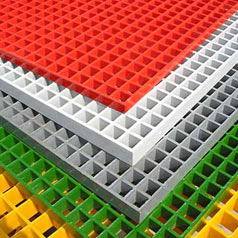
Molded Fiberglass Gratings
Bidirectional Strength
Square / Rectangular Mesh
Concave / Grit Top
Molded with interwoven continuous E-glass rovings in a liquid thermosetting resin bath. Delivers equal bi-directional structural load distribution, allowing field cutouts around pipelines and vessels with zero perimeter unraveling.
Formed by pulling continuous glass roving strands through heated steel dies. Boasts high mechanical glass volume (up to 70%), providing maximum stiffness and modulus of elasticity for long-span walkways and pipe-bridge crossings.
Combines a molded or pultruded base grating with an integral solid chequered or grit-coated composite top plate. Ideal for odor control covers in municipal wastewater digestion basins and cleanroom liquid containment zones.
Fiberglass vs. Galvanized & Stainless Steel The True Life-Cycle Cost Reality
Procurement directors increasingly look beyond initial purchase price (CapEx) to total life-cycle expense (OpEx). While hot-dip galvanized carbon steel has an attractive upfront metric, exposure to saltwater spray, hydrogen sulfide, or acidic chemicals compromises zinc passivation within 3 to 7 years, necessitating expensive grit-blasting, re-galvanizing, or hazardous panel hot-work shutdowns.
Omkar Gratings manufactures both world-class electroforged carbon steel and high-tier fiberglass gratings. Our engineering audits prove that fiberglass delivers dramatic savings across corrosive industrial envelopes:
Immunity to Electrolytic & Chemical Rust: Resins do not oxidize or corrode in harsh pH 1–14 environments.
Elimination of Heavy Crane Rigging: Weighing one-third of steel, panels are safely positioned by a two-man crew without mobile cranes.
Zero Hot-Work Permits: Cutting FRP requires only handheld diamond masonry blades—no explosive torch work, grinding sparks, or fire-watch crews.
Matching Chemical Chemistry to Environmental Severity
The structural performance of fiberglass gratings relies on thermoset resin integrity. Specifying the incorrect resin matrix is the primary cause of premature softening, structural fiber-bloom, and delamination. Omkar Gratings formulates four standardized resin systems tailored to engineering demands:
Orthophthalic Polyester (Grade O): Standard grade for municipal architectural walkways, footbridges, light washrooms, and standard water treatment access.
Isophthalic Polyester (Grade I): Formulated for industrial processing facilities exposed to splash and vapor from mild mineral acids, salts, alkalis, and outdoor coastal environments.
Vinyl Ester (Grade V): Premium bisphenol-epoxy vinyl ester for direct immersion or high-concentration chemical contact with chlorine, sulfuric acid, caustic soda, and marine bilge waters.
Phenolic (Grade P): Specialized offshore and tunnel resin offering maximum fire resistance, practically zero smoke generation, and extreme high-temperature structural retention.
Global Sourcing Trends: Decarbonization, Automation, and Smart Infrastructure
The global industrial procurement landscape for composite gratings is undergoing a massive structural transformation. Global EPC contractors, municipal authorities, and plant asset owners are shifting specifications toward fiberglass gratings based on three accelerating market drivers:
Lower Embodied Carbon: Compared to electric-arc furnace steel and smelting intensive stainless steel, pultrusion and composite manufacturing processes generate substantially lower lifecycle CO2 emissions per square meter.
Electrification & Data Infrastructure: The exponential growth of battery gigafactories, solar farms, EV charging hubs, and AI hyperscale data centers requires completely non-magnetic, dielectric flooring that eliminates electrical arcing risks.
BIM & Modular Skid Pre-fabrication: EPC contractors increasingly order precision CNC-routed panels directly bundled with stainless 316 clips, labeled and tagged directly to structural engineering drawings for instant skid assembly.
Standard Molded Fiberglass Grating Load & Dimensional Specifications
Review standard industrial mesh configurations. Omkar Gratings custom machines bearing bar heights, wall tapers, and panel dimensions to project specifications.
Depth / Height (mm)
Mesh Pattern (c/c mm)
Bar Thickness Top/Bottom (mm)
Open Area (%)
Panel Weight (kg/m²)
Recommended Max Clear Span (mm)
Typical Applications
25 mm (1")
38 x 38 (Square)
6.5 / 5.0
68%
12.3
750 mm
Pedestrian walkways, catwalks, cooling tower fan decks, screen walkways
30 mm (1.25")
38 x 38 (Square)
6.5 / 5.0
68%
14.6
900 mm
Wastewater aeration tanks, chemical sump pits, light industrial platforms
ADA compliant walkways, cart corridors, drop-tool safety platforms
50 mm (2")
50 x 50 (Square)
8.0 / 6.0
72%
24.0
1350 mm
Heavy vehicular trench grates, chemical plant rolling stock crossings
* Note: Permissible continuous uniform loading calculations are based on standard L/100 deflection for pedestrian comfort or L/200 for sensitive plant equipment. Contact our engineering department for comprehensive FEA analysis and concentrated point load deflection charts.
Complete Industrial Catalog
Comprehensive Flooring, Gratings & Cable Support Portfolio
As one of India's established manufacturers and global exporters, Omkar Gratings provides turnkey integration of metallic and composite access structures.
Electroforged Steel Gratings
Fused under 100+ tonnes of hydraulic pressure and 2200 A current for seamless structural steel flooring.
Common AI & Buyer Questions: Fiberglass Gratings Engineering
Direct technical answers to the most frequent queries searched by global procurement and structural engineering teams.
What is the structural difference between molded and pultruded fiberglass gratings?
Molded fiberglass gratings possess bidirectional mechanical strength due to an interwoven continuous roving structure, allowing for complex multi-angle cutouts without compromising structural integrity. Pultruded gratings feature unidirectional load-bearing bars with high roving density (up to 70% glass content), offering substantially greater stiffness and load capacity over longer spans, but requiring directional orientation and additional framing support for irregular penetrations.
How do resin formulations (Orthophthalic, Isophthalic, Vinyl Ester, Phenolic) affect fiberglass grating performance?
Resin systems determine the thermal, chemical, and fire behavior of the grating. Orthophthalic polyester serves moderate atmospheric conditions and commercial pedestrian zones. Isophthalic polyester provides robust resistance in moderate industrial acid and salt environments. Vinyl ester offers premium structural resilience against harsh acids, alkalis, oxidizers, and coastal saline sprays. Phenolic resins deliver maximum fire retardancy with ultra-low smoke and toxic gas emissions, compliant with ASTM E84 Class 1 and USCG standards for offshore marine environments.
Can fiberglass gratings directly replace galvanized mild steel and stainless steel gratings?
Yes, in applications governed by chemical exposure, electrolytic corrosion, weight limitations, or spark hazards. While structural steel possesses a higher modulus of elasticity, FRP fiberglass gratings deliver superior strength-to-weight ratios (weighing roughly one-third of steel), zero cathodic rust, non-conductivity, and no post-installation galvanizing or pickling requirements. Proper selection requires checking deflection limits (typically L/100 or L/200) under anticipated point and uniform loads.
What installation fixing clips and hardware grades are required for fiberglass gratings?
Fiberglass gratings are secured using specialized 316-grade stainless steel clips: Type M clips for securing bearing bars to support beams, Type C clips to tie adjacent unsupported panel edges to minimize differential deflection, and Type G clips for mechanical clamping to flange structures without drilling. A minimum of 4 clips per panel or 4 clips per square meter is recommended to prevent vibration displacement.
How does ultraviolet (UV) radiation and weathering affect fiberglass gratings over a 20-year lifespan?
Industrial fiberglass gratings manufactured by Omkar Gratings integrate UV inhibitors directly into the thermosetting liquid resin, complemented by a synthetic surfacing veil that shields the outer glass rovings. In aggressive tropical or desert sun, surface 'fiber bloom' may cause slight cosmetic color fading over decades, but structural tensile and flexural capacities remain safely within design margins.
Need an Engineered Fiberglass Grating Package with Full Certification?
Send your structural specifications, layout drawings, and target resin requirements. Omkar Gratings' engineering team provides complete deflection checks, bill-of-material optimization, and competitive export pricing.