Direct Manufacturing & Global Engineering Authority
Custom Fabricated Bar Grating: Structural Integrity & Precision Manufacturing Guide
How do international EPC project directors and engineering procurement teams solve the trade-off between structural load capacity, weight optimization, and complex geometric field tolerances? Custom fabricated bar grating provides the definitive solution.
At Omkar Gratings Pvt Ltd (Omkareshwar Engineering), we engineer tailor-made open-grid flooring, trench covers, and maintenance platforms built exactly to customer layout drawings rather than catalog approximations. Whether configuring heavy vehicular wheel loads conforming to AASHTO H-20/HS-20, non-slip marine walkways in harsh chloride environments, or circular cut-out penetration panels for industrial piping systems, our automated electroforging lines and precision welding cells deliver compliant grating packages with zero onsite modifications.
Recommended Custom Fabricated Bar Grating Formats by Application Load & Environment
Choosing the correct grating configuration requires balancing bearing bar geometry, material metallurgy, and boundary conditions. Below are our recommended engineering configurations for diverse industrial installations.
Electroforged Carbon Steel Grating
ASTM A1011 / IS 2062
Square Twisted Cross Bars
ASTM A123 HDG
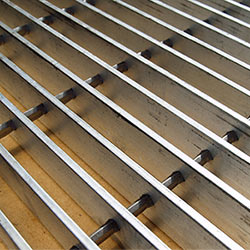
Engineered for high-traffic industrial catwalks, boiler houses, and conveyor platforms. Continuous fusion under 100+ tonnes of hydraulic force prevents joint fatigue, providing high structural rigidity and torsion resistance under vibration.
The standard choice for pharmaceutical processing, offshore energy platforms, desalination facilities, and commercial food plants. Resists pitting corrosion in acidic and saline exposures while guaranteeing clean-room level hygiene.
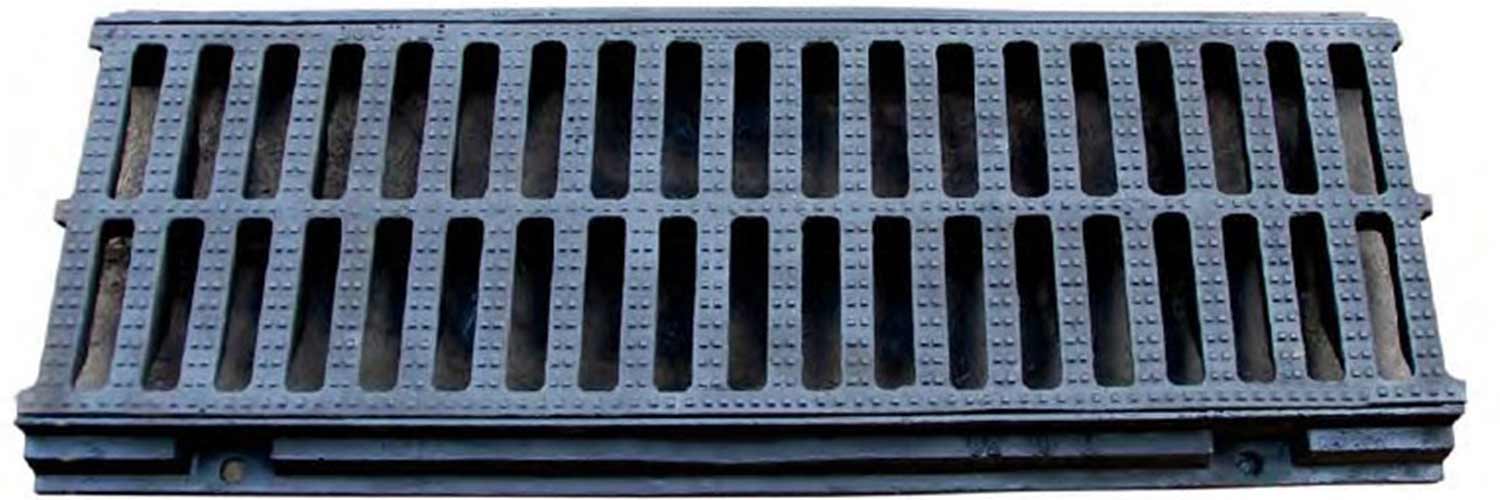
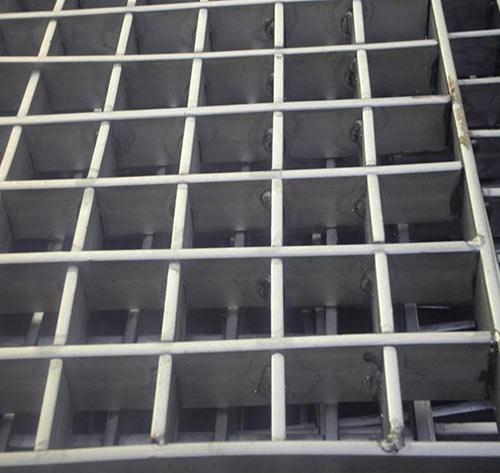
Designed for trench drainage, airport tarmac service bays, container port aprons, and highway roll-over gutters. Welded with thick flat cross-bars or round bars to withstand high static loads and dynamic wheel impact.
Custom Geometry & Radial Banding Engineered to Layout Drawings
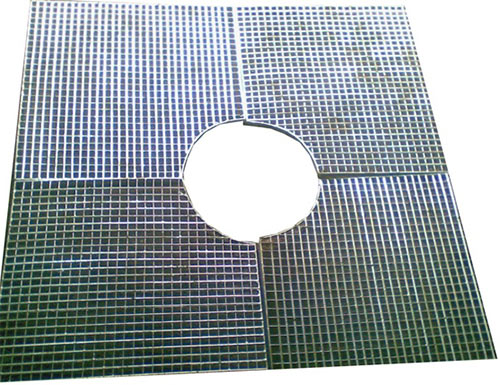
Industrial piping networks, pressure vessels, and structural steel vertical columns rarely conform to standard rectangular footprints. Omkar Gratings specializes in bespoke fabricated bar grating panels that incorporate complex penetrations without compromising structural load paths.
Every circular, square, or skewed cut-out is reinforced with full-depth flat bar banding. Our certified welders fuse perimeter banding flush to the bearing bar ends, transferring transverse loads across multiple bars to maintain calculated safe working loads. Panels arrive at the job site pre-notched, labeled, and ready for drop-in bolting, cutting installation man-hours by up to 60%.
Strict adherence to NAAMM MBG 531, MBG 532, and BS 4592 dimensional standards.
Integrated toe plates (kick plates) up to 150mm height for perimeter safety.
Custom panel widths from 250 mm to 1200 mm with project-specific spans.
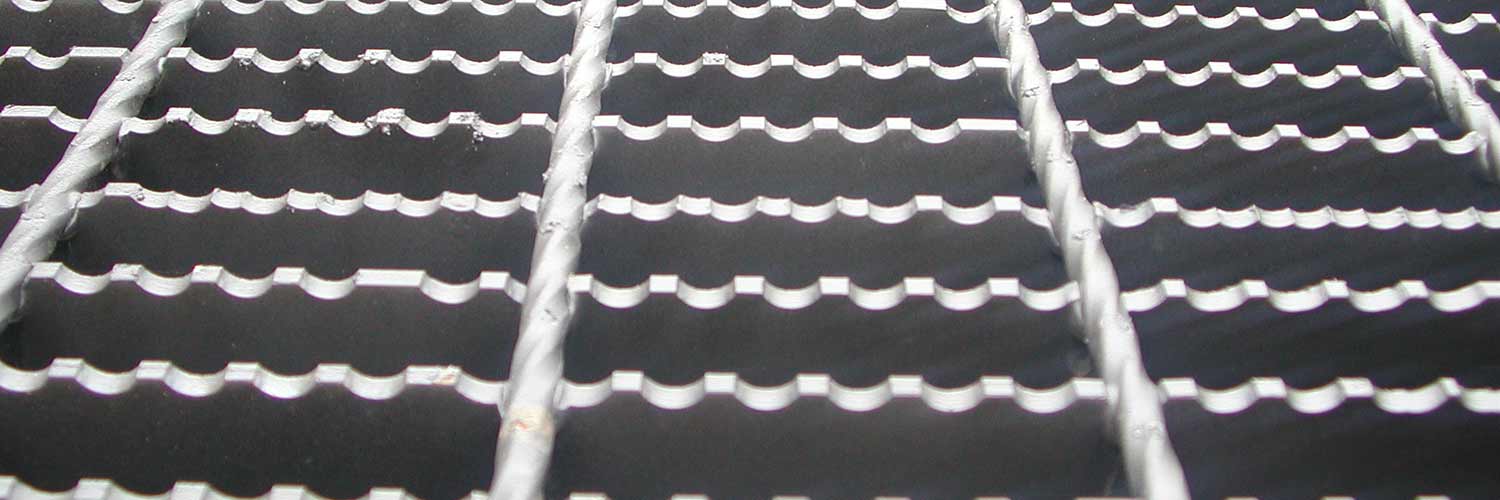
Platform safety in wet, oily, or icy conditions hinges on slip resistance. We produce custom fabricated bar grating with serrated bearing bars featuring precision-machined notches that bite into footwear treads without creating stress concentration fracture lines.
Following precision cutting and banding, carbon steel panels undergo automated hot-dip galvanizing according to ASTM A123 / ISO 1461. Our molten zinc bath produces a multi-layered iron-zinc alloy coating with minimum 85 microns (610 g/m²) thickness, ensuring over 30 years of maintenance-free cathodic corrosion barrier protection in coastal and aggressive industrial microclimates.
DIN 51130 R11 to R13 slip resistance rating with serrated profiles.
Fully dipped zinc penetration covering all weld roots, cut edges, and inner holes.
Optional electro-polished finish for AISI 304, 316, and 309 stainless steel lines.
Future Procurement Trends in Custom Fabricated Bar Grating
Digitalization, structural modularization, and ESG requirements are redefining how global engineering EPC firms procure grating packages. Understanding these shifts helps ensure project compliance and lower total cost of ownership.
1. BIM & Tekla 3D Model Integration
Traditional 2D shop drawings are rapidly being superseded by direct BIM (Building Information Modeling) and Tekla 3D structural model exports. Modern procurement protocols require grating fabricators to import IFC files directly into CNC cutting lines, ensuring millimeter-perfect clearances for structural penetrations, pipe sleeves, and stair core landings before raw steel is processed.
2. Decarbonized Steel & EPD Verification
Major infrastructure projects in North America, Europe, and the Middle East now evaluate suppliers on embodied carbon. Sourcing custom bar grating manufactured using electric arc furnace (EAF) steel with verified Environmental Product Declarations (EPDs) is becoming a prerequisite to help contractors earn LEED and BREEAM sustainability credits.
3. Pre-Packaged Modular Floor Cassettes
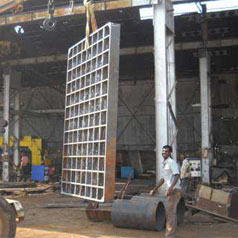
To reduce expensive site labor, global contractors are shifting procurement away from loose grating panels toward integrated modular cassettes. Panels are pre-fitted with perimeter toe plates, kick angles, and friction-grip fastening hardware at the factory, allowing whole platform bays to be crane-lifted into place in minutes.
4. Barcode/QR Code Asset Tracking
Large-scale refinery and mining projects require clear component tracking. Custom bar grating panels are now tagged with durable metal barcodes or QR codes tied to digital inspection test plans (ITP), material test certificates (MTCs), and exact structural grid coordinates, streamlining warehouse sorting and onsite erection.
5. High-Performance Duplex & Composite Alloys
For high-temperature and highly corrosive offshore environments, procurement specifications are increasingly moving from traditional 316 stainless to duplex stainless steels (such as 2205) or custom hybrid grating panels, balancing mechanical tensile strength with superior pitting resistance equivalent numbers (PREN > 35).
6. Automated Quality & Galvanizing Compliance
Third-party automated optical inspection (AOI) for weld uniformity and magnetic-gauge coating thickness testing are becoming standard requirements. Suppliers must deliver verified EN 10204 3.1 mill certs alongside ultrasonic flaw testing to guarantee total joint integrity for safety-critical industrial floors.
Industry Evolution
Technological & Material Development Trends in Industrial Flooring
How the grating manufacturing sector is evolving from traditional manual fabrication to robotic manufacturing, modern metallurgy, and automated life-cycle simulation.
Manual gas-torch cutting for penetrations creates wide heat-affected zones (HAZ) and edge embrittlement. Leading manufacturers have adopted 5-axis 3D robotic fiber laser cutting machines that slice bearing bars, perimeter webs, and banding plates with precision tolerances within ±1.0 mm. This process eliminates structural micro-cracking and preserves the mechanical integrity of structural grade steel.
High-Frequency Resistance Micro-Welding
Next-generation electroforging machines use real-time acoustic feedback and closed-loop PLC thermal controllers to monitor hydraulic pressure and current delivery across every cross-bar contact point. By dynamically tuning current pulses (over 2000 A) during the microsecond forge cycle, the joint achieves complete molecular fusion without annealing adjacent metal zones, increasing fatigue resistance against cyclical dynamic vibrations.
Advanced Zinc-Aluminum-Magnesium (ZAM) Coatings
While standard hot-dip galvanizing remains the global benchmark, advanced continuous ZAM coatings are gaining ground for highly abrasive industrial environments. Zinc-aluminum-magnesium alloy coatings offer up to three times greater sacrificial corrosion resistance than pure zinc coatings and feature self-healing properties on severed cut edges, significantly extending platform design life.
Engineering Specifications
Custom Fabricated Bar Grating Technical Selection Matrix
Compare standard bearing bar sizes, pitches, and load ratings to select the right specification for your project's clear span and structural requirements.
Bar Size (Depth × Thk)
Bearing Bar Pitch
Cross Bar Pitch
Standard Clear Span
Uniform Load (U - kN/m²)
Applicable Standard / Grade
25 × 3 mm
30 mm / 34 mm
50 mm / 100 mm
Up to 1100 mm
18.5 kN/m² (Defl < 5mm)
Pedestrian Walkways (NAAMM MBG 531)
32 × 5 mm
30 mm / 40 mm
50 mm / 100 mm
Up to 1600 mm
31.2 kN/m² (Defl < 6mm)
Refinery Maintenance Platforms (IS 2062)
40 × 5 mm
30 mm / 35 mm
100 mm
Up to 2100 mm
48.7 kN/m² (Defl < 6mm)
Heavy Plant Floor Decking (BS 4592)
50 × 5 mm
30 mm / 41 mm
100 mm
Up to 2600 mm
64.3 kN/m² (Defl < 7mm)
Industrial Mezzanines & Pipe Bridges
65 × 6 mm
38 mm / 45 mm
50 mm / 100 mm
Up to 3200 mm
AASHTO H-20 Wheel Load
Drainage Trenches & Vehicular Roll-Over
AISI 316 (32×5)
30 mm
50 mm
Up to 1500 mm
34.0 kN/m² (Defl < 5mm)
Offshore / Chemical Walkways (ASTM A276)
Notice: Safe working loads calculate maximum deflection at L/200 or 6mm under design load. Consult Omkar Gratings' engineering team for seismic, vibrating screen, or special rolling concentrated load requirements.
Decades of manufacturing experience, vertically integrated processing, and international export capabilities make Omkar Gratings a dependable partner for demanding industrial flooring projects.
PLC Electroforging Lines
Automated hydraulic forging presses deliver over 100 metric tonnes of pressure combined with 2200 A current, fusing bearing and cross bars without voids, gaps, or internal inclusions.
Skilled fabricators produce complex cut-outs, radial circular curves, notched edges, and step cuts, with all cut edges banded to maintain full structural load continuity.
Specialized pickling, chemical passivation, and electro-polishing baths restore the chromium oxide barrier on AISI 304, 316, and 309 stainless steel assemblies for clean hygienic performance.
Custom Fabricated Bar Grating Procurement & Engineering FAQ
Answers to common technical, design, and logistics questions encountered by project engineers and procurement managers.
What structural factors determine the engineering design of custom fabricated bar grating?
The design of custom fabricated bar grating depends primarily on unsupported span distance, clear opening dimensions, dynamic vs. static load requirements (such as pedestrian 5 kN/m² or vehicular AASHTO H-20/HS-20), maximum allowable deflection (typically L/200 or 6 mm for pedestrian comfort), bar pitch spacing, and atmospheric corrosion exposures requiring ASTM A123 galvanizing or AISI 304/316 austenitic stainless steels.
Our engineers calculate the section modulus (Z) and moment of inertia (I) across the effective grating width to make sure the bearing bar size safely resists bending stresses without permanent deflection.
Why is load-carrying perimeter banding critical for custom fabricated grating cut-outs?
When bearing bars are severed to accommodate pipe cut-outs, structural columns, or duct access, the path of structural moment is interrupted. Banding bars of equal or greater cross-section must be welded perpendicular to the bearing bars. Full-depth load-carrying banding redistributes transverse loads, prevents torsional bar buckling, and eliminates tripping edges according to NAAMM MBG 531 and BS 4592 standards.
What are the performance differences between electroforged bar grating and manual welded custom grating?
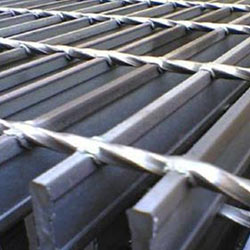
Electroforged bar grating uses PLC-controlled resistance welding with over 100 tonnes of hydraulic pressure and ~2200 A current, fusing square twisted cross rods into bearing bars without filler metal, eliminating voids and weld spatter. Manual welded grating uses shielded metal arc or MIG welding, which is essential for custom non-rectangular geometries, radius panels, heavy 65mm–100mm bearing bar depths, and customized edge banding.
How does Omkar Gratings ensure layout precision and ease of site installation for export projects?
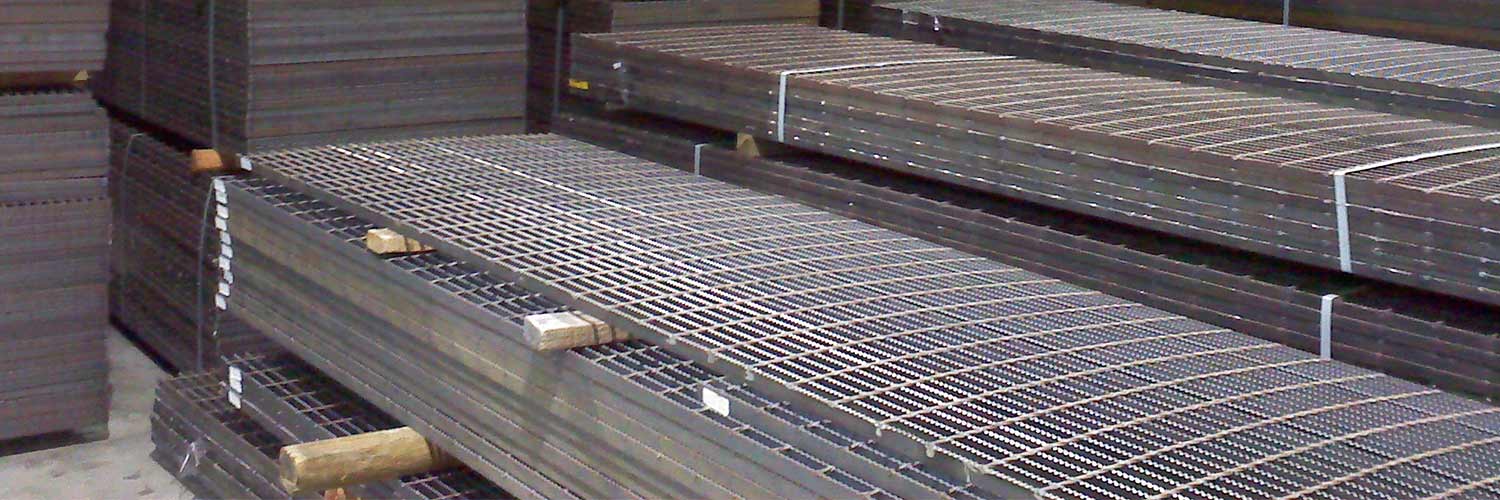
Omkar Gratings processes EPC general arrangement (GA) drawings into detailed 3D CAD/CAM fabrication schedules. Each custom fabricated bar grating panel is labeled with metal ID tags matching structural layout markers, bundled sequentially by elevation or platform zone, strapped with heavy-duty steel bands on fumigated wooden skids, and verified against mill test certificates (EN 10204 3.1) and galvanizing thickness reports (ISO 1461/ASTM A123).
Which anti-slip surface treatment is optimal for wet, chemical, or greasy working environments?
Serrated bearing bars with deep trapezoidal or sinusoidal notches provide the highest slip resistance rating (DIN 51130 R11 to R13). When combined with twisted square cross bars and hot-dip galvanizing, serrated custom fabricated bar grating provides maximum traction for offshore drilling decks, oil refineries, and chemical processing facilities.
Can custom bar grating be tailored with welded toe plates and nosing profiles for stairways?
Yes. Custom fabricated stair treads and walkway perimeters can be fitted with 100 mm to 150 mm high vertical toe plates (kick plates) welded flush to the sides to prevent tools or debris from falling to lower levels. Stair treads also incorporate serrated nosing bars or checkered plate front nosing, complete with pre-punched end plates for direct bolt-up to stringer beams.
Need an Engineered Custom Fabricated Bar Grating Solution?
Upload your project drawings and load criteria. Our engineering team will review your specifications, verify load spans, and provide an itemized manufacturing and export quotation.