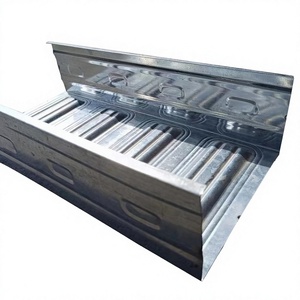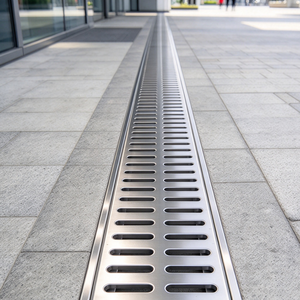
Explore our heavy-duty platforms, perimeter drainage channels, cable management trays, and structural safety profiles tailored for Gulf infrastructure tenders.
A rigorous examination of grating longevity across the coastal and desert operating zones of Kuwait.
Industrial infrastructure in Kuwait faces combined stresses: sustained atmospheric operating temperatures surpassing 50°C (122°F), ambient UV irradiance, and high airborne chloride concentrations originating from Arabian Gulf coastal spray. Conventional electro-galvanized or painted carbon steels quickly suffer micro-fissuring and catastrophic delamination under these conditions.
Our CE-certified stainless steel bar gratings leverage stabilized AISI 316L austenitic stainless steel, containing a minimum of 2.0%–2.5% Molybdenum. This structural chemistry achieves a Pitting Resistance Equivalent Number (PREN) ≥ 23.5, providing superior resistance against chloride ion penetration. After automated hydraulic pressure-welding or electroforging, every panel undergoes a multi-stage chemical immersion: complete pickling in nitric-hydrofluoric acid solutions followed by electropolishing. This eliminates heat tints, dissolves free-iron contaminants, and restores a uniform chromium oxide (Cr&sub2;O&sub3;) passive film across every joint fillet.
In accordance with EN ISO 14122-2 and BS 4592-0 industrial flooring standards, our designs maintain precise deflection thresholds (≤ 1/200th of effective span) under standard static uniformly distributed loads (UDL) of 5.0 kN/m² and concentrated loads of 1.5 kN applied via a 200×200 mm contact plate.
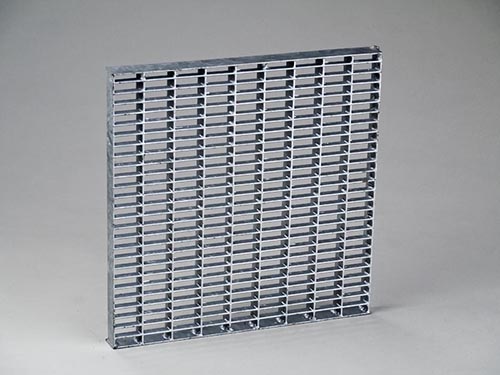
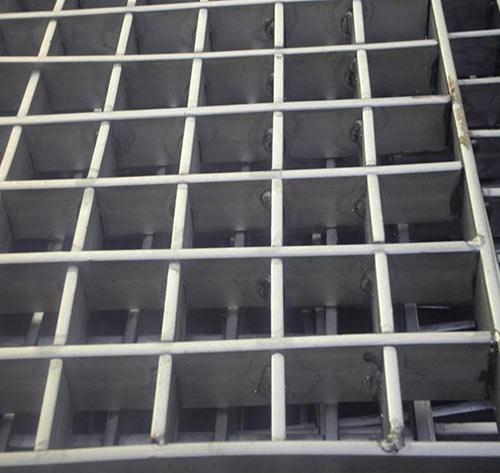
Standard imported bar grating is often held together by intermittent manual tack welding, creating micro-voids, slag inclusions, and stress risers prone to accelerated crevice corrosion. Our automated PLC-controlled electroforging facility applies simultaneous hydraulic forging pressure exceeding 100 metric tons with a targeted low-voltage, high-amperage current burst (~2200 Amperes).
This process heats the contact interface between the square-twisted cross bar and the vertical load-bearing bar into a plasticized state, forging the two elements into an uninterrupted, monolithic junction without external filler metal. For stainless steel grades (AISI 304/316), high-pressure resistance welding maintains strict dimensional tolerances with near-zero angular distortion, ensuring structural integrity during cyclic thermal expansion in desert operations.
Every cut-out for piping, equipment columns, or valve penetrations is edge-banded with a full-depth flat bar welded at 100% of contact points. This redistributes load path dynamics and keeps pedestrian surfaces secure and compliant with international safety codes.
| Alloy Grade | Composition (Cr-Ni-Mo) | Yield Strength (Rp0.2) | Finish Treatment | Recommended Kuwait Applications |
|---|---|---|---|---|
| AISI 304 (1.4301) | 18.0% Cr / 8.0% Ni | ≥ 230 MPa | Acid Washed & Glass Beaded | Commercial architectural trenches, commercial kitchen drains, dry inland plant walkways. |
| AISI 316 (1.4401) | 16.5% Cr / 10.0% Ni / 2.0% Mo | ≥ 240 MPa | Electro-Polished (Ra < 0.4 μm) | KNPC/KOC petrochemical refining platforms, offshore docks, seawater intake screening. |
| AISI 316L (1.4404) | 16.5% Cr / 10.0% Ni / 2.0% Mo (Low C) | ≥ 220 MPa | Electro-Chemical Passivated | Thermal desalination plants (MSF/RO), subsea pipeline tie-ins, chemical injection skids. |
| AISI 309 / 310S | 24.0% Cr / 13.0% Ni / 0.2% C | ≥ 205 MPa | High-Temp Annealed | Furnace access walkways, power plant flare stack perimeters, high-temperature exhaust zones. |
Engineered to satisfy the rigid engineering standards of MEW, KOC, KNPC, and leading private regional developers.
Supplying hydrocracking units, sulfur handling lines, and offshore loading jetties with high-load SS316L electro-polished walkways that withstand hydrocarbon vapors, caustic wash cycles, and high thermal variances.
Serving Ministry of Electricity & Water (MEW) facilities such as Doha West, Subiya, and Az-Zour South. Non-corroding SS316 grating panels secure pump pits, brine discharge canals, and seawater intake chambers.
From prestigious multi-level retail malls to municipal headquarters across Kuwait City, our linear heel-proof SS304 trench grates combine clean architectural aesthetics with ADA slip-resistance compliance.
Certified, hygienic floor drainage for dairy processing, confectionery packaging, and commercial cold storage where CIP (Clean-in-Place) chemicals, acidic exposure, and zero-bacteria surfaces are required.
Perforated SS316 and hybrid FRP/stainless cable systems providing non-magnetic, flame-retardant cable management that prevents localized inductive heating across multi-megawatt switchgear rooms.
High-capacity marine-grade heavy-duty gratings for Boubyan Island container terminals. Engineered for container reach-stacker loadings, harsh salt spray, and extreme hydraulic surge forces.
Aligning fabrication methodologies with Kuwait Vision 2035 (New Kuwait) infrastructure megaprojects.
Public authority procurement (including MEW and MPW) has historically favored carbon steel with 85-micron hot-dip galvanizing. However, high maintenance cycles in seaside corridors—where zinc sacrificial coatings can degrade within 36 to 48 months—have shifted EPC feasibility modeling toward 30-year Life-Cycle Costing. Specifying pickled and electropolished AISI 316 stainless steel eliminates routine repainting, reduces structural downtime during refinery turnarounds, and lowers the long-term cost per square meter across operating lifespans.
Mega urban developments like the Silk City development, expanded terminals at Kuwait International Airport (T2), and cultural center renovations require pedestrian safety designs without sacrificing drainage efficiency. Demand has accelerated for 8 mm to 10 mm bar spacing (heel-proof/ADA compliant) that prevents slender footwear entrapment while maintaining hydraulic flow rates over 450 liters/min per linear meter through smooth electropolished channels.
Tougher project inspection frameworks across the Gulf require robust supply chain verification. Leading consultants reject mill batches lacking full chemical and mechanical provenance. Certified grating manufacturers must provide EN 10204 Type 3.1 Inspection Certificates alongside third-party testing (PMI, destructive tensile testing, Charpy V-notch impact, and ASTM A262 Practice E intergranular corrosion testing) to ensure compliant installation on critical path projects.
Combining automated heavy manufacturing, complete in-house fabrication, and specialized Gulf export logistics.
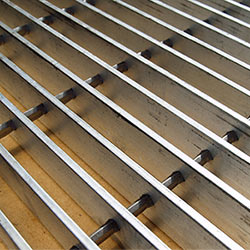
Equipped with computerized high-capacity forge-welding lines delivering up to 100 tonnes of hydraulic pressure and 2200 A current. Produces clean, gap-free, seamless junctions that withstand heavy industrial wear.
Certified fabrication across prime AISI 304, 316, 316L, 309, and duplex stainless grades. In-house XRF positive material identification (PMI) confirms metallurgical compliance prior to cutting and welding.
Automated cutting, banding, and radial notch shaping directly from customer AutoCAD and Tekla files. Panels range from 250 mm to 1200 mm widths, fitted with toe plates, kick plates, and notched clearances.
Comprehensive surface treatment facilities: automated pickling and acid washing tanks, high-grade electropolishing, and hot-dip galvanizing baths compliant with ASTM A123 / EN ISO 1461 requirements.
Supplying complete industrial access packages: electroforged gratings, FRP pultrusions, cable trays, chequered plates, stair treads, handrails, and heavy-duty ductile iron gully frames under one vendor roof.
Structured palletization, waterproof interleaving, and reinforced maritime crating designed for Gulf ports (Shuwaikh & Shuaiba). Clearly tagged panels match site erection drawings for rapid field assembly.
Essential guidance on certifications, logistics, material selection, and structural compliance.
Send your structural layout drawings, loading criteria, and material specifications to our sales engineers for complete technical takeoffs and export pricing.
Get a Quote