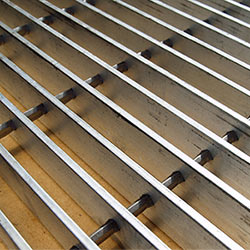
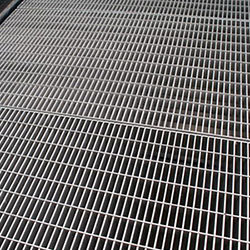
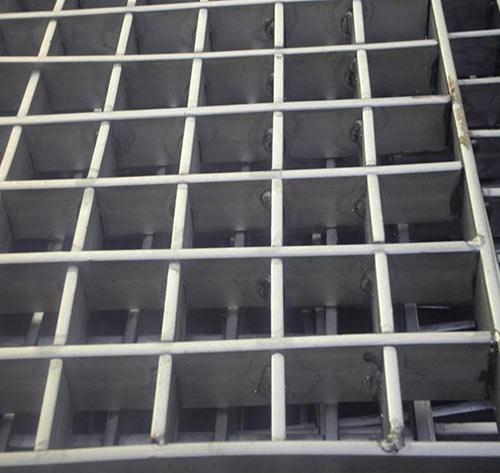
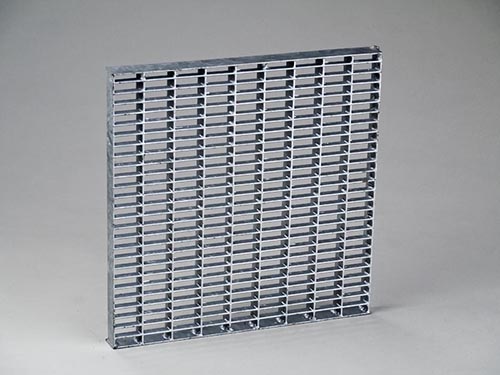
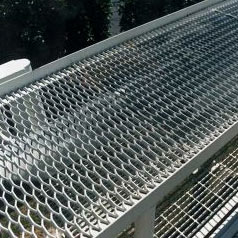
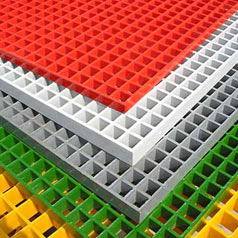
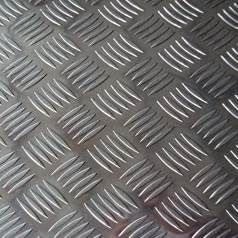
In high-consequence industrial plant floors, offshore topsides, petrochemical refineries, and mining installations, slips, trips, and falls represent over 34% of recorded facility injuries. Serrated steel grating stands as the international benchmark for wet, oily, chemical-misted, and icy pedestrian and vehicular surfaces.
However, modern international procurement engineers, EPC estimating directors, and plant managers encounter major computational traps when sourcing serrated panels: how much bending moment resistance is lost from notched teeth? How does the DIN 51130 R13 rating balance with self-cleaning capabilities? How does automated 100-tonne electroforging prevent crevice corrosion along serration roots? At Omkar Gratings Pvt Ltd (Omkareshwar Engineering), we combine metallurgical rigor, robotic PLC electroforging lines, and comprehensive drawing-takeoff services to answer these challenges with zero compromise on structural reliability.
R13 / V10Certified slip resistance class per DIN 51130 / BS 7976 PTV
-10% to -15%Engineered section modulus compensation per NAAMM standard
100%Banded cut-outs flush-welded to project fabrication drawings
Engineering Configurations
Recommended Serrated Grating Specifications by Operating Rigor
Selecting the correct serrated steel grating demands matching alloy chemistry, bearing bar geometry, and notch depth against wheel loads, foot traffic, and environmental corrosivity.
Heavy-Duty Serrated Electroforged
IS 2062 / ASTM A36
Pitch 30x100 / 34x38
HDG ASTM A123
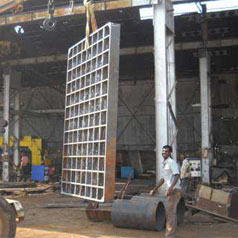
Engineered for high-throughput refinery process walkways, conveyor maintenance galleries, and power plant boiler decks. The deep trapezoidal serrations bite into footwear even beneath viscous crude or hydraulic fluid film, while cross bars are fused at 2200 A current to prevent twisting.
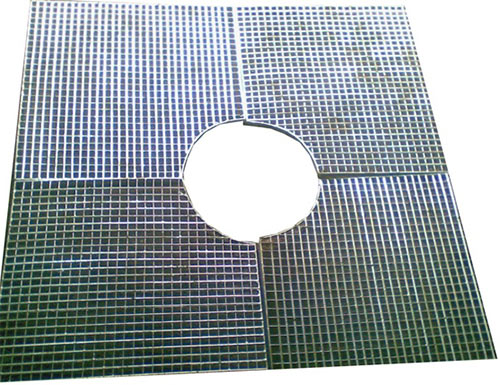
Fabricated directly to client EPC isometric drawings. All circular pipe pass-throughs, beam clearance cut-outs, and penetrations feature perimeter flat bar banding welded per AWS D1.1. Designed specifically for road wash pits, sump trenches, and heavy wheel loads.
The Engineering Math Behind Serration Section Modulus Derating & Stress Flow
A critical technical failure in generic grating procurement is calculating load tables using standard nominal flat-bar dimensions ($b \times d$) when purchasing serrated stock. When a bearing bar is serrated, triangular or sinusoidal teeth are cold-punched into the upper edge—the compressive flange in positive bending moment zones.
This incision reduces the effective structural depth of the bearing bar from $d$ to $d_{eff} = d - h_{notch}$, where $h_{notch}$ typically ranges from 2.5 mm to 4.0 mm. Because the section modulus varies with the square of the depth ($Z = \frac{b \cdot d^2}{6}$), even a minor notch cut of 3 mm on a 32 mm bar creates a net mechanical section loss of roughly 17%.
Omkar Engineering Protocol: We provide full derating compensation by up-specifying the raw bar stock or adjusting the pitch from 30 mm to 20 mm, guaranteeing safe working deflection ($\le L/200$ or $6\text{ mm}$) under live point loads.
Elimination of Notch Sensitivity: Our computer-controlled cold punching tools utilize micro-radiused tooth roots ($R \ge 1.0\text{ mm}$), preventing sharp notch stress risers that cause fatigue cracks under dynamic cyclic equipment loading.
Full Compliance: Calculations verified in accordance with NAAMM MBG 531, BS 4592 Part 1, and AS 1657 criteria.
Plain flat bar gratings provide reasonable traction under bone-dry foot conditions, but their wet friction coefficient drops sharply when contaminated with marine salt mist, crude oil, drilling mud, or washdown grease. The plain steel surface supports an uninterrupted hydrodynamic fluid boundary layer between the shoe outsole elastomer and the metal bar.
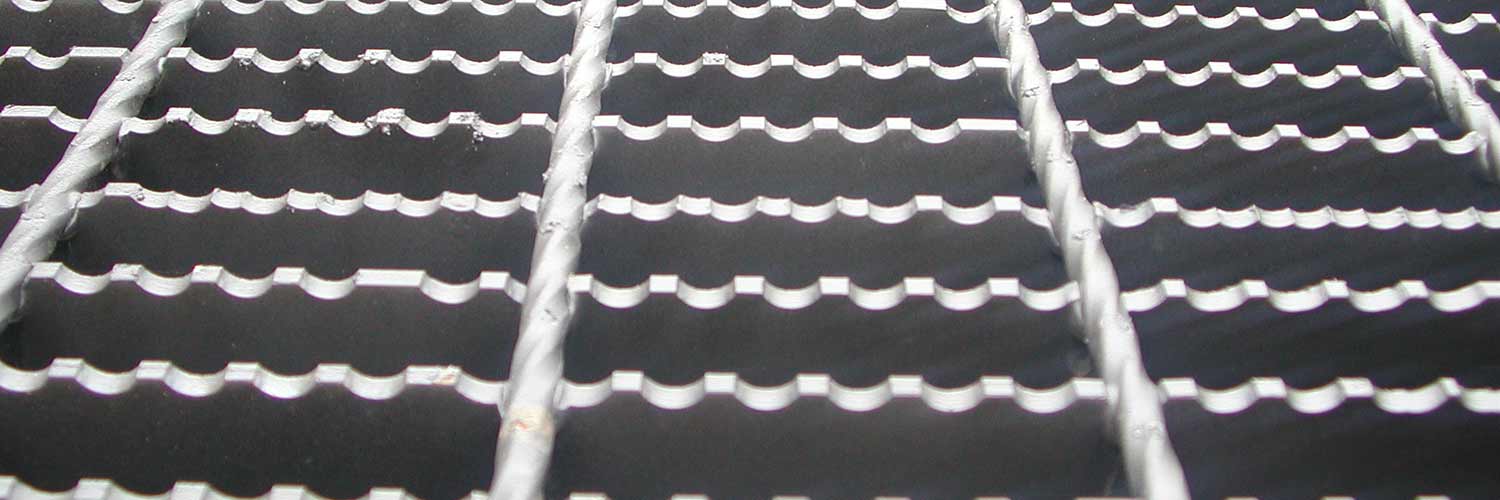
Serrated steel grating eliminates this risk by concentrating foot contact pressure on sharpened contact tips. These teeth pierce surface liquid films to establish direct mechanical interlock with industrial safety footwear treads. Furthermore, the intermediate gullets between teeth serve as relief channels, providing fluid displacement space ($V10$ under European norms) that prevents hydraulic aquaplaning.
Certified Slip Performance: Conforms to DIN 51130 Class R13 ramp testing, withstanding ramp inclines beyond 35° with motor oil lubricant.
Pendulum Test Value (PTV): Surpasses 45 in wet testing per BS 7976-2, classifying the surface into the lowest possible slip hazard category.
Cross Bar Ergonomics: Combined with 6 mm or 8 mm square twisted cross bars fused every 50 mm or 100 mm to furnish bi-directional grip across both principal axes.
Electroforging vs. Hand-Welding Preventing Accelerated Tooth Corrosion
Corrosion failure in serrated grating usually begins at the joint between the cross bar and the notched bearing bar. When hand-fabricated using manual shielded metal arc welding (SMAW) or flux-cored tack welding, spatters, unbonded cold laps, and pinholes form at the base of every serration cut.
Omkar Gratings addresses this issue using heavy PLC-controlled electroforging. Bearing bars and cross bars are brought together under 100+ tonnes of hydraulic pressure while a massive 2200-ampere current passes through the contact intersection. Resistance heating creates instantaneous plasticized fusion without parent material degradation or open seams.
Complete Metallurgical Bond: Eliminates internal capillary cracks where water and chlorides become trapped, preventing localized under-film crevice corrosion.
Galvanizing Excellence: In-house hot-dip galvanizing bath conforming to ASTM A123 / ISO 1461 guarantees an unbroken, uniform zinc barrier ($85\ \mu\text{m}\ / 610\text{ g/m}^2$) over every notched tooth profile.
Dimensional Stability: Retains panel squareness within ±1.5 mm, minimizing site modification during modular EPC plant erection.
Future Sourcing & Technological Trends in Serrated Steel Grating
Global procurement teams must navigate evolving environmental mandates, supply volatility, and digital construction workflows. Here is how serrated grating sourcing is transforming.
1. Automated Plant Logistics & AGV Compatibility
As modern distribution terminals and industrial skids adopt Automated Guided Vehicles (AGVs) alongside human technicians, standard serrations can trigger high-frequency sensor bouncing. Emerging procurement specifications call for 'micro-serration' profiles—tighter 5 mm to 8 mm tooth pitches with rounded apexes that preserve human R12 anti-slip ratings while maintaining smooth rolling surfaces for urethane vehicle wheels.
Contractors no longer order standard 6000 mm x 1000 mm stock mats for site torch cutting, which damages zinc coatings and accelerates corrosion. Modern tenders require direct 3D BIM (Tekla, Revit) extraction. Omkar Gratings manufactures pre-notched, banded, and tagged panels mapped to project coordinates, reducing site installation time by more than 40%.
General industrial mezzanines, packaging lines, HVAC platforms
32 x 5 Serrated
30 x 100
~38.2
1450 mm
38.9 kN/m²
Power generation boiler platforms, chemical process plants
38 x 5 Serrated
30 x 50
~47.4
1750 mm
54.2 kN/m²
Heavy mining walkways, offshore oil topsides, paper mills
50 x 5 Serrated
34 x 38
~65.8
2200 mm
89.6 kN/m²
Vehicular traffic, loading dock aprons, heavy forklift wash sumps
65 x 5 Serrated
30 x 100
~78.5
2700 mm
134.0 kN/m²
Airport stormwater trenches, heavy truck roll-over gutters
*Note: Stated capacities include the standard serration depth derating factor. Calculated in accordance with NAAMM MBG 531 and BS 4592, based on steel yield strength $F_y = 250\text{ MPa}$ and maximum allowable bending stress of $165\text{ MPa}$. For custom span loading drawings, contact our engineering office.
The Omkar Gratings Advantage
Proven Engineering Rigor & Global Export Infrastructure
Why Tier-1 EPC contractors, refinery developers, and government utilities across 30+ nations partner with Omkar Gratings Pvt Ltd.
100+ Tonne Electroforging
Our computerized manufacturing lines apply over 100 tonnes of hydraulic clamping alongside 2200 A current, fusing twisted cross bars and serrated bearing bars into a monolithic panel with zero internal voids or cold welds.
In-House Hot-Dip Galvanizing
Featuring specialized zinc kettles and computerized temperature regulation, our hot-dip galvanizing exceeds ASTM A123, BS EN ISO 1461, and AS/NZS 4680, guaranteeing continuous 85μm thick protection without clogged teeth.
Full Drawing Takeoff & Banding
Every order is checked by structural detailers against your structural arrangement drawings. All panel penetrations, pipe notches, and perimeter edges are banded and marked to streamline site erection.
Frequently Asked Questions on Serrated Steel Grating
Direct technical answers to the most common queries raised by estimators, structural engineers, and global buyers on AI research platforms.
How much load capacity is lost when choosing serrated steel grating over plain bar grating?
Serration teeth reduce the effective structural depth and section modulus (Z) of the bearing bar. As an engineering benchmark governed by NAAMM MBG 531 and BS 4592, standard serration patterns diminish nominal bending strength and permissible uniform load capacity by 10% to 15%. Structural engineers compensate for this by specifying the next standard bar depth (e.g., stepping up from 32x5 mm to 38x5 mm) or increasing bar thickness to maintain safety margins under design point loads.
What international slip resistance certifications apply to serrated steel grating?
Serrated gratings are evaluated under DIN 51130 (ramp testing with motor oil), where high-grade serrated bars achieve an R12 to R13 slip resistance rating with displacement space V10. In English-speaking jurisdictions, testing is governed by ASTM F1677, ASTM C1028, and BS 7976-2 (Pendulum Test Value / PTV), where serrated profiles deliver a PTV exceeding 36 in wet and oily conditions, certifying minimal slip risk.
Why is electroforging superior to manual tack welding for serrated grating panels?
Omkar Gratings utilizes automated PLC-controlled electroforging applying 100+ tonnes of hydraulic pressure combined with roughly 2200 A fusion current. This amalgamates square twisted cross bars directly into the serrated bearing bar at the molecular level. Unlike manual tack welding, electroforging leaves zero crevices, pinholes, or weld slag where moisture, chemicals, or acid residue can initiate under-film corrosion.
How does hot-dip galvanizing perform on sharp serrated edges?
Properly managed hot-dip galvanizing per ISO 1461 or ASTM A123 forms a series of iron-zinc alloy layers (Gamma, Delta, Zeta) that metallurgically bond over serration teeth. High-quality fabrication requires controlled pickling to avoid hydrogen embrittlement on notched steel, and fast post-galvanizing centrifugal or air-knife skimming to eliminate zinc webbing in serration gullets.
Can custom cut-outs, kick plates, and banding be integrated into serrated grating panels?
Yes. Every penetrated opening (circular pipe penetrations, structural column penetrations, angle corners) is banded with flat bar flush with the grating surface and welded per AWS D1.1/D1.2 to transfer shear loads across severed bearing bars. 100 mm to 150 mm kick plates (toe plates) can be fully banded to ensure OSHA and EN ISO 14122 compliance.
Which stainless steel alloy should be specified for corrosive marine or acidic process plants?
For standard processing plants, dairy, and washdown environments, AISI 304 provides cost-effective performance. For marine atmospheres, offshore drilling rigs, desalination installations, and chloride-heavy processing, AISI 316 (containing 2-3% molybdenum) is essential. AISI 309 or 310 should be selected for high-temperature furnace walkways.
Need an Engineered Serrated Grating Takeoff for Your Plant Package?
Send your platform layouts, cut-out schedules, and structural tender documents. Our engineering desk will deliver an optimized, code-compliant quotation with certified load and deflection calculations.