Galvanized Stair Treads Manufacturer & Suppliers in the Portugal Market
Engineered Electroforged & Serrated Metal Grating Steps Complying with EN ISO 14122-3, ISO 1461, and Eurocode Standards for Atlantic Marine and Industrial Corridors
100+ t
Hydraulic Electroforge Force
85–100 μm
ISO 1461 Galvanizing Bath
EN 14122
EU Safety Compliance
C4 / C5-M
Marine Corrosion Resistance
Factory-Direct Catalog
Engineered Galvanized Stair Treads & Metal Grating Steps
Precision-welded stair treads designed for heavy loading, slip prevention, and extreme durability across industrial platforms, logistical hubs, and commercial stair towers.
Engineering Foundations: Structural Design of Galvanized Stair Treads
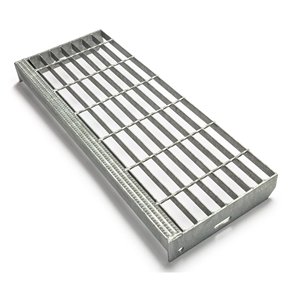
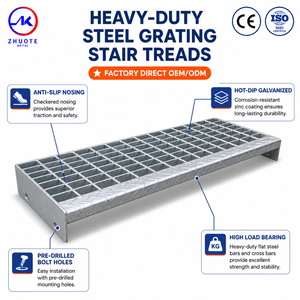
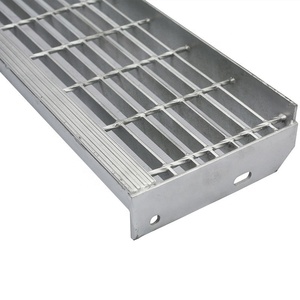
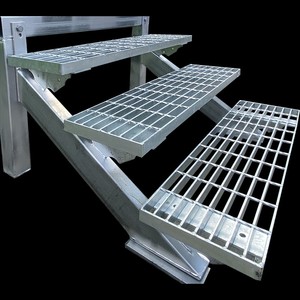
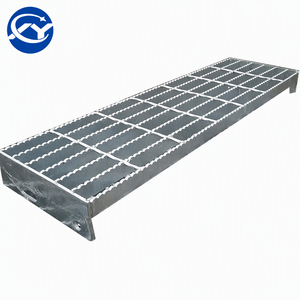
In structural engineering and industrial facility design across the Iberian Peninsula, stair treads serve as primary egress and access mechanisms that cannot afford mechanical failure. A galvanized stair tread consists of longitudinal structural bearing flat bars spaced at regular pitches (typically 30 mm, 34 mm, or 40 mm), transverse cross bars (twisted square bars or round rods), specialized bolted or welded side end-plates (carrier plates), and a high-traction anti-slip nosing bar.
Mechanical Load Integrity: Designed in compliance with European Standard EN ISO 14122-3, every step tread must support an evenly distributed imposed load of 5.0 kN/m² and a concentrated point load of 1.5 kN applied at the most adverse position over an area of 100 mm × 100 mm on the front nosing edge, restricting vertical deflection to not exceed 1/300th of the tread's unsupported clear span (maximum 6.0 mm).
Unlike ordinary manual hand-welded gratings that suffer from thermal distortion, uneven fusion depths, and high internal residual stress, our electroforged stair treads are manufactured on high-tonnage PLC-automated forge-welding production lines. The machine applies in excess of 100 metric tonnes of hydraulic compression while discharging approximately 2200 Amperes of instantaneous electrical resistance heating. This solid-state metallurgical fusion amalgamates the square twisted cross bar directly into the pre-notched bearing bar without adding filler wire, eliminating crevices, open weld seams, and oxidation pockets that otherwise trigger early galvanic fatigue.
Engineering Matrix
Standard Technical Specifications & Dimensional Profiles
Precision-dimensioned configurations engineered for European DIN 24531-1 hole layouts and high-frequency industrial plant access.
Model Code
Bearing Bar (Depth × Thk)
Mesh Pitch (BB × CB)
Standard Lengths (L)
Standard Widths (W)
Front Nosing Profile
Slip Class (DIN 51130)
ST-303-S
30 × 3 mm (Serrated)
34 × 38 mm
600, 700, 800, 900 mm
240, 270, 305 mm
Pyramid Punched Plate
R12 Rated
ST-325-S
32 × 5 mm (Serrated)
30 × 100 mm
800, 900, 1000, 1200 mm
270, 305 mm
Perforated Cast-In Bar
R13 Rated
ST-403-P
40 × 3 mm (Plain)
34 × 38 mm
900, 1000, 1200 mm
240, 270, 305 mm
Chequered Plate Nosing
R11 Rated
ST-405-HD
40 × 5 mm (Serrated)
30 × 50 mm
1000, 1200, 1500 mm
270, 305, 325 mm
Serrated Angle Flange
R13 Heavy Duty
ST-505-XHD
50 × 5 mm (Serrated)
30 × 100 mm
1200, 1500, 1800 mm
305, 325 mm
Diamond Pattern Grip
R13 Extreme
Portugal Deployment
Localized Industrial Applications in the Portuguese Territory
From the high-salinity Atlantic coastline to chemical refinement and renewable energy infrastructure, discover how our galvanized stair treads operate in Portugal's demanding operational environments.
Port Logistics & Deepwater Terminals
The Port of Sines, Port of Leixões (Matosinhos), and Port of Setúbal handle high-throughput container traffic, cryogenic natural gas (LNG), and bulk liquid transshipment. Structures here encounter severe ISO 12944 C5-M marine exposure conditions.
Corrosion Protection: Heavy-duty zinc coverage exceeding 85 μm to endure ocean wave aerosol and high salinity.
Debris Clearance: 80%+ open surface geometry prevents salt crust and seawater pooling on shipboard access gangways.
Structural Resilience: Withstands heavy stevedore foot-traffic and continuous vibration from marine loading arms.
Green Hydrogen & Renewable Energy Corridors
Portugal’s National Hydrogen Strategy (EN-H2) and offshore wind hubs near Viana do Castelo require safety-critical stair systems for electrolyzer facilities, substations, and wind turbine service towers.
Non-Sparking Traction: Serrated bearing surfaces matched with anti-slip nosing avoid worker slippage during offshore service.
Chemical Inertness: Resistant to alkaline environments and steam purge washdowns in green ammonia plants.
Structural Weight Optimization: High strength-to-weight ratio minimizes secondary structural steel tonnage on elevated racks.
Pulp, Paper, Cork & Agro-Industrial Plants
Key Portuguese domestic industries—such as The Navigator Company’s mills in Figueira da Foz and Setúbal, as well as cork facilities in Aveiro and Alentejo wine estates—demand rigorous floor hygiene and chemical endurance.
Moisture & Tannin Washoff: Open grating grids allow fast drainage of processing liquor, pulp slurry, and wash water.
Thermal Cycling: Unyielding dimensional stability when exposed to outdoor solar baking and indoor steam boiler zones.
Low Maintenance: Hot-dip galvanization completely removes the need for periodic re-painting or rust remediation.
Macro Market Trends: Green Industrialization & Normative Modernization in Portugal
The architectural and civil engineering sectors in Portugal are experiencing a generational pivot. Fueled by the European Recovery and Resilience Facility (PRR - Plano de Recuperação e Resiliência), capital projects are emphasizing three decisive operational benchmarks: prolonged infrastructure lifespan, strict adherence to European harmonization standards, and cradle-to-gate carbon transparency.
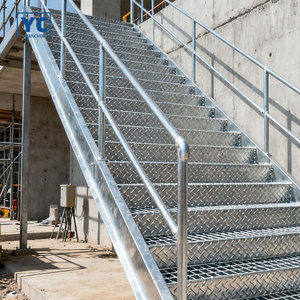
1. Stringent Transposition of EN ISO 14122-3 into Portuguese Labor Regulations: Under Decree-Law no. 50/2005 (Prescrições mínimas de segurança e de saúde para a utilização pelos trabalhadores de equipamentos de trabalho), industrial staircases must incorporate standardized rise and going dimensions, distinct high-contrast slip-resistant nosing, and structural carrier end-plates with standardized European DIN 24531 bolt centers. EPC contractors in Porto, Coimbra, and Lisbon are rejecting generic imported grating steps in favor of certified, fully traceable structural assemblies.
2. Transition from Painting to ISO 1461 Continuous Hot-Dip Zinc Galvanization: Because Portugal's primary economic corridor lies within 30 km of the Atlantic Ocean, standard painted mild steel stairs undergo paint film delamination, underfilm blistering, and structural cross-section loss within 24 to 36 months. Portuguese industrial operators now mandate hot-dip galvanizing with specified bath compositions (low silicon / nickel micro-alloyed) that develop ductile, metallurgically bonded Gamma, Delta, and Zeta iron-zinc alloy layers beneath a crystalline pure zinc Eta outer layer, delivering a design service life in excess of 25 years without maintenance.
3. High-Traction Serration for Severe Rainy Seasons: The northern maritime regions (Minho and Douro Litoral) experience high annual precipitation exceeding 1,200 mm. Untextured flat steel tread bars present significant slip-and-fall hazards when exposed to rainfall mixed with industrial dust or oils. This has prompted structural engineering specifications to switch to trapezoidal serrated bearing bars delivering DIN 51130 R12 and R13 slip resistance certifications.
Manufacturing Pedigree
Factory-Direct Engineering & Global Supply Advantages
Combining heavy-duty PLC electroforge manufacturing technology with rigorous European quality assurance systems for seamless integration into Portuguese capital projects.
100+ Ton Electroforging Fusion
Our automated forge-welding presses fuse twisted cross bars into load-bearing bars under 100 tonnes of hydraulic force and 2200A current, generating monolithic joints without heat cracks, porosity, or weak spots.
EN 10025 Certified European Steels
All stair treads are fabricated from fully verified structural steel grades (S235JR and S355JR) supplied with complete EN 10204 3.1 chemical analysis and tensile test certification for guaranteed Eurocode load compatibility.
Hot-Dip Galvanizing to ISO 1461
Processed in computerized molten zinc baths at 450°C. We ensure consistent zinc coating weights between 610 g/m² and 900 g/m² (85 to 125 μm thickness), exceeding standard ASTM A123 and Portuguese infrastructure requirements.
Precision CAD/CAM Custom Cutouts
Whether your project requires spiral stair geometries, circular cutouts for pipe penetrations, toe-plates, or unique carrier end-plate bolt spacing, our in-house engineering team manufactures directly to your approved fabrication drawings.
Heavy Anti-Skid Nosing Profiles
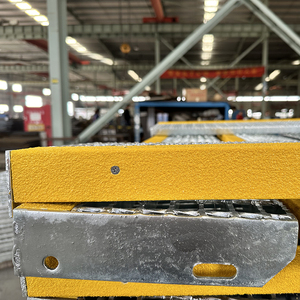
Equipped with specialized high-traction nosing plates—including perforated round hole profiles, pyramid pattern plates, or chequered safety edges—enhancing pedestrian visibility and workplace slip safety.
Export Packaging & Ocean Freight Direct
Products are crated in seaworthy, steel-strapped bundles with heavy corner protectors and moisture barriers, shipping directly via FCL/LCL ocean lines to the Port of Leixões, Lisbon, and Sines with full customs documentation.
Buyer Guidance
Frequently Asked Questions by Portuguese Procurement Teams
Detailed technical, logistical, and compliance answers addressing the primary concerns of Portuguese fabricators, EPC contractors, and purchasing managers.
What European standards govern the design and fabrication of stair treads for use in Portugal?
Stair treads deployed in Portugal must conform to EN ISO 14122-3 (Safety of machinery - Permanent means of access to machinery: Stairs, stepladders and guard-rails). Structurally, the fabrication aligns with EN 1090-2 Execution Class 2 (EXC2) for structural steelwork. Dimensions, end-plate carrier hole pitches, and nosing specifications routinely follow DIN 24531-1, while hot-dip galvanizing must comply strictly with EN ISO 1461, ensuring load capacities align with Eurocode 1 (EN 1991-1-1).
How do electroforged stair treads compare with manual welded bar gratings in coastal Portuguese areas?
Manual MIG/MAG welded gratings introduce microscopic weld spatter, inconsistent penetration depths, and localized undercut cracks. When installed along Portugal's Atlantic coastline (such as Sines, Matosinhos, or Aveiro), salt air penetrates these micro-crevices, triggering early corrosion that undermines structural safety. In contrast, electroforged stair treads merge the twisted square cross bar into the bearing bar under 100+ tonnes of force and 2200A resistance heating. This forms a continuous, seamless joint with zero weld voids, providing superior adhesion for molten zinc and tripling corrosion resistance.
What zinc coating thickness is recommended for industrial installations along the Atlantic coastline?
For inland applications (such as Castelo Branco or Évora), standard ISO 1461 minimum galvanizing thickness of 55 to 70 μm is adequate. However, for Atlantic coastal zones categorized as ISO 12944 C4 or C5-M marine environments, we recommend a controlled hot-dip galvanizing process producing an average thickness between 85 μm and 110 μm (approx. 610–780 g/m²). This provides reliable protection against high airborne chlorides, saline fog, and cyclical wet-dry Atlantic weather patterns.
What are standard hole center configurations for carrier end plates according to DIN 24531-1?
Standard carrier side plates come equipped with slotted bolt holes (typically 14 × 28 mm to accommodate M12 bolts) to absorb erection tolerances on structural stringers. For standard tread widths:
• Width 240 mm: Front edge to first hole = 45 mm, bolt center distance (n) = 120 mm.
• Width 270 mm: Front edge to first hole = 45 mm, bolt center distance (n) = 150 mm.
• Width 305 mm: Front edge to first hole = 55 mm, bolt center distance (n) = 180 mm.
Custom hole distributions and stringer connection cleats can also be laser-drilled to match your site drawings.
Can stair treads be supplied with custom circular or irregular cutouts for pipe penetrations?
Yes. Our engineering division processes custom architectural and mechanical CAD layouts. Every circular, square, or diagonal cutout is framed with edge banding bars (kick-plates or flat bars identical in depth to the bearing bar) that are welded full-depth to restore structural load transfer. Panels and individual steps are marked with erection identification numbers matching site general arrangement (GA) drawings for straightforward on-site installation.
What anti-slip rating is achievable for rainy or oily industrial walk surfaces?
Standard plain bearing bar treads provide an R10 slip rating, which is adequate for indoor dry facilities. For wet, outdoor, or oily operating conditions (such as olive oil processing facilities, petrochemical terminals, and outdoor marine docks), we supply serrated bearing bars combined with perforated pyramid nosing plates. This configuration achieves an R12 to R13 rating under DIN 51130, delivering exceptional traction even when wet with water, diesel, or industrial greases.
What is the typical shipping lead time and logistics procedure to Portugal?
Standard project lead times are 2 to 3 weeks for fabrication and hot-dip galvanizing, followed by direct ocean container transit to the main Portuguese deepwater ports: Port of Leixões (serving Greater Porto and northern industrial zones) or Port of Sines / Lisbon (serving central and southern industrial corridors). Ocean transit typically takes 22 to 28 days. Shipments include full customs export packing, mill test certificates (EN 10204 3.1), commercial invoices, packing lists, and Certificate of Origin documents.
Request an Engineered Quotation for Your Portuguese Project
Partner directly with an established electroforged metal grating and stair tread manufacturer. Forward your technical specifications, bill of quantities (BOQ), or structural stringer drawings to our application engineers for a prompt, competitive quotation.