Precision-manufactured flooring, industrial stairs, FRP structural systems, and utility access assemblies optimized for high-load, high-salinity Iraqi installations.
A technical guide for EPC project managers, mechanical package leaders, and procurement directors operating across the Republic of Iraq.
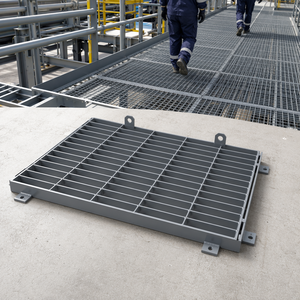
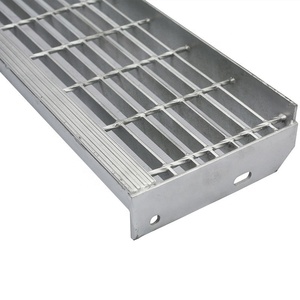
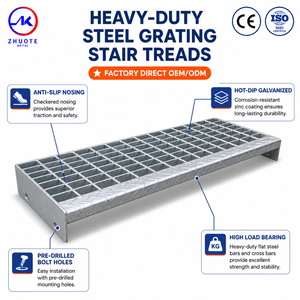
Industrial reconstruction in the Republic of Iraq presents an aggressive operational environment characterized by extreme ambient temperatures fluctuating from below zero during winter desert nights to over 52°C in mid-summer, coupled with high concentrations of atmospheric airborne sand, hydrogen sulfide ($H_2S$) outgassing in crude extraction zones, and hyper-saline coastal humidity in the Basra Governorate. Procurement of standard smooth bar grating under such operating conditions frequently leads to severe occupational hazards, premature coating spallation, and catastrophic slip accidents due to accumulated crude films, drilling mud, and particulate buildup. Consequently, engineering guidelines issued by the Ministry of Oil (MoO), South Oil Company (BOC / SOC), Midland Oil Company (MDOC), and the State Company for Oil Projects (SCOP) explicitly stipulate serrated steel grating fabricated to international structural standards (BS 4592-1, ANSI/NAAMM MBG 531, and ASTM A1011).
As a seasoned manufacturing powerhouse and dedicated exporter to the Middle East, our production plant operates PLC-controlled high-pressure electroforging technology. By applying over 100 metric tons of hydraulic pressure synchronously combined with approximately 2,200 Amperes of electrical resistance current, our machines fuse square-twisted cross bars homogeneously into serrated bearing bars. This forge-welding metallurgical process forms an impervious, integral joint devoid of cracks, weld spatters, or internal voids—eliminating the localized crevice corrosion commonly observed in manually arc-welded alternatives on Iraqi refinery cat-walks.
From the Rumaila and West Qurna oil fields to the gas processing plants of Khor Al-Zubair, see how our serrated grating fulfills strict local engineering criteria.
In massive installations like Rumaila, Zubair, and Majnoon, wellhead platforms and degassing stations (DS) deal with thick hydrocarbon deposits and crude condensate. Serrated bearing bars provide an aggressive mechanical grip, piercing viscous oil slicks to safeguard drill-rig operators and maintenance crews during night shifts.
At the Baiji Rehabilitation complex, Daura Refinery in Baghdad, and the Basra Refinery expansion, structural stair towers and fractionating column catwalks demand high thermal tolerance and unobstructed natural ventilation to purge volatile vapors while supporting severe vertical live loads.
The Grand Faw Port megapipeline and Umm Qasr container jetties experience persistent sea salt aerosol, tidal splashing, and brackish mud. Here, heavy-duty hot-dip galvanized serrated grating or 316L stainless pressure-welded panels prevent corrosion under severe marine immersion conditions.
Standard design configurations complying with international deflection criteria (≤ 1/200th of span, max 6mm under operational load).
| Bearing Bar Profile & Dimensions | Pitch (Bearing / Cross Bar) | Standard Steel Grade | Corrosion Protection System | Max Recommended Clear Span | Nominal Weight (kg/m²) |
|---|---|---|---|---|---|
| Serrated 25 x 3 mm (Trapezoidal Teeth) | 30 x 100 mm / 34 x 38 mm | ASTM A36 / S275JR | Hot-Dip Galvanized ≥ 70 μm | 850 mm (Walkway Pedestrian) | ≈ 19.8 kg |
| Serrated 30 x 3 mm (Deep Serration) | 30 x 100 mm | ASTM A36 / Q235B | Hot-Dip Galvanized ≥ 80 μm | 1,050 mm (Industrial Walkway) | ≈ 23.4 kg |
| Serrated 32 x 5 mm (Heavy-Duty Industrial) | 30 x 50 mm / 30 x 100 mm | ASTM A1011 / S355JR | Hot-Dip Galvanized ≥ 85 μm | 1,300 mm (Pump Station Mezzanine) | ≈ 41.2 kg |
| Serrated 40 x 5 mm (High Load Heavy-Duty) | 30 x 100 mm | IS 2062 Grade E250 / S275 | ASTM A123 ≥ 90 μm | 1,650 mm (Trench & Forklift Loading) | ≈ 50.8 kg |
| Serrated 50 x 5 mm (Substation / Heavy Haul) | 30 x 100 mm / 40 x 100 mm | S355JR / BS EN 10025 | Hot-Dip Galvanized ≥ 100 μm | 2,100 mm (Transformer Sump / Culverts) | ≈ 63.5 kg |
| Serrated Stainless AISI 316L | 30 x 100 mm | ASTM A240 / TP316L | Acid Pickled & Electro-Polished | 1,200 mm (Acid Skids & Marine Docks) | ≈ 39.5 kg |
Analysis of regulatory evolution, inspection mandates, and modern modularization trends.
1. Shift from On-Site Stick-Built Welding to Modular Pre-Fabricated Gratings: In major refinery upgrade packages overseen by international consultancies (such as Technip, Saipem, Petrofac, and JGC) in Southern Iraq, field hot-work permits are strictly limited due to active gas line perils. Procurement orders have shifted rapidly toward pre-cut, CNC-notched, banded grating panels manufactured directly to 3D architectural models. Supplying factories must deliver marked panels tied to computerized layout drawings, ensuring rapid drop-in site installation without on-site flame cutting that destroys galvanized anti-rust integrity.
2. Tightening of Galvanizing Standards Due to Desert-Marine Microclimates: Atmospheric exposure across Basra, Fao, and Khor Al-Zubair combines hyper-saline maritime humidity with high concentrations of sulfur dioxide ($SO_2$) and salt-laden airborne silica dust. Standard commercial coatings of 45 microns degrade within 24 to 36 months under this abrasive sandblasting microclimate. State entities and private project managers now demand ASTM A123 or ISO 1461 zinc coatings with a verified minimum average thickness of 85 to 100 microns (equivalent to 610–700 g/m²), verified using magnetic pull-off thickness gauges during third-party inspection stages.
3. Rigorous Mandate for Pre-Shipment Inspection (BV, SGS, TÜV) & Certificate of Conformity: Under the Iraqi General Scheme of Verification of Conformity (VOC), industrial shipments bound for the Port of Umm Qasr or Trebil border crossings require an authorized inspection agency (such as Bureau Veritas or SGS) to issue a Certificate of Inspection (COI) and Certificate of Conformity (COC). Grating suppliers must maintain seamless traceability of steel heat certificates, yield and tensile strength testing reports, mill test reports (MTR), and zinc purity bath assays (≥98.5% pure zinc) to prevent demurrage bottlenecks at customs entry points.
Building upon decades of specialized fabrication experience, our industrial production facilities combine heavy-forge automation with strict international quality compliance:
Practical technical and commercial answers addressing common engineering queries.
Electroforged serrated grating is manufactured on high-speed automated PLC production lines that simultaneously apply over 100 tons of hydraulic pressure and high electrical current (approx. 2200 A) to fuse square-twisted cross bars into serrated bearing bars without using any filler metal. This creates a solid, homogeneous joint with zero internal air pockets, cracks, or weld slag. In contrast, manual hand-welded grating relies on individual arc welds at joint intersections, which are prone to porosity, uneven penetration, burn-throughs, and residual weld spatter. In high-vibration applications or corrosive refinery environments like Basra, manually welded joints frequently crack under dynamic equipment loads and form localized crevice corrosion cells.
Iraqi oil facilities—including wellpads, separator stations, and manifold decks in Rumaila, West Qurna, and Halfaya—are subject to blowing sand and fine desert silt that mixes with residual crude oil, condensate, or drilling lubricants on walking surfaces. Plain flat bar gratings become exceptionally slick and hazardous under these conditions. The precision-machined trapezoidal serrations on our bearing bars provide a sharp mechanical bite that cuts through grease films and liquid layers, providing superior friction and anti-slip safety conforming to international occupational safety standards (OSHA 1910.22 and BS 4592).
We implement a strict four-stage surface preparation protocol comprising hot alkaline degreasing, hydrochloric acid pickling with corrosion inhibitors, fluxing in ammonium chloride, and hot-dip galvanizing in high-purity zinc kettles operating at 450°C. For high-corrosion zones like Umm Qasr, Fao, and coastal petrochemical hubs, we exceed the standard 60-70 micron coating thickness, providing a certified average zinc thickness of 85 μm to 120 μm (up to 850 g/m²) in accordance with ASTM A123 / BS EN ISO 1461. For acid concentration skids or sulfur-recovery units, we supply electro-polished AISI 316L stainless steel gratings with molybdenum content exceeding 2.0%.
Yes. Over 70% of our export projects for Iraqi oil, gas, and power infrastructure require custom pre-fabrication. We work directly from Tekla, AutoCAD, or BIM structural files to incorporate circular pipe penetration cut-outs, column notches, and equipment clearances. All cut-outs are reinforced and bordered with 5mm or 6mm flat steel banding bars, and integrated 100mm x 6mm toe plates (kick plates) are welded wherever required by safety codes. Panels are clearly stenciled with piece marks corresponding to site erection layout drawings for rapid installation without on-site burning or cutting.
We provide full documentation dossiers with every shipment, including: Mill Test Certificates (EN 10204 Type 3.1) stating chemical composition and mechanical properties (Yield, Tensile, Elongation), Galvanizing Compliance Reports with magnetic coating thickness checks, Load and Deflection Test Data, and dimensional inspection sheets. We coordinate directly with third-party inspection agencies such as Bureau Veritas, SGS, TÜV, and Intertek at our factory to perform visual checks, dimensional verification, and loading tests required to issue the Certificate of Conformity (COC) needed for smooth entry at Umm Qasr or Trebil.
Our monthly production capacity exceeds 3,500 metric tons of electroforged and fabricated gratings, allowing us to complete standard refinery orders of 20 to 100 containers within 15 to 25 production days. Shipments are loaded into 20ft or 40ft heavy-duty containers or breakbulk holds, with direct maritime transit to Umm Qasr Port typically requiring 12 to 22 days depending on the shipping line (such as Maersk, CMA CGM, or MSC). We also handle direct CIF / CFR incoterms, providing all legalization and chamber-attested consular invoices where required.
Submit your material specifications, engineering take-offs, or structural CAD layouts to our dedicated Middle East export desk for a fast response, comprehensive quotation, and technical load verification.